Showing posts with label Thomas Mitchell. Show all posts

Monday, 16 May 2011

Only Angels Have Wings - 1939


“Only Angels Have Wings” (1939) is a quintessential film of 1939, I would suggest for two reasons. First, its “boys’ own adventure” type story of a band of mail flyers in South America would be the end of the Depression era adventures, the last bit of intrigue in a far away land before World War II, which would turn very young real-life fliers into men under horrific circumstances. The aimless flyers in “Only Angels Have Wings” haven’t any such worries. They are not responsible for a nation’s freedom. They can’t even be responsible for themselves.

Somewhere out there in the tropical mist, we are on the cusp of a more treacherous world, a more grown up world. One gets the feeling Cary Grant is trying to hold it off as long as possible.

The second element that makes this movie such a prime example of 1939 is the presence of character actor Thomas Mitchell, who played in five of the top movies that golden year, all winners. Besides this one, he was in “The Hunchback of Notre Dame”, “Gone with the Wind”, “Mr. Smith Goes to Washington”, and “Stagecoach”, for which he won the Oscar for Best Supporting Actor. It’s not a 1939 film without Thomas Mitchell.

For classic movie buffs, 1939 has always been regarded as the banner year, when the Hollywood movie factories churned out on their assembly lines a greater than usual number of excellent films. This post is part of the Classic Movie Blog Association “Classic Films of 1939 Blogathon” which runs from May 15th through the 17th. Have a look here at the website for a listing of bloggers and their 1939 films. Looks like a lot of great reading.

In this essay, I’d like to look at “Only Angels Have Wings” through the prism of 1939 and not so much about what we know about that year, but what we may have forgotten about it. The biggest thing we often forget is that we’re watching current events. This film marks the end of a timeline in an era, though I rather imagine director Howard Hawks, himself a former flier, would not have recognized that when he made it. It had only been some 12 years previous to the making of this movie that Charles A. Lindbergh, “Lucky Lindy” flew the first non-stop solo flight across the Atlantic Ocean. That generation of seat-of-the-pants fliers like Lindy and Amelia Earhart, the Granville Brothers, and Bessie Coleman, were still part of the American popular culture; though some of them had already been killed in their daring exploits. These were still the days when airplane flight brought out the press and the newsreels cameras, where records made for huge headlines and parades.

Most people alive in 1939 could remember a time when there were no airplanes.

A week or so after “Only Angels Have Wings” premiered in May 1939, an unusually large number of the original cast, including Cary Grant, Jean Arthur, Richard Barthlemess, Rita Hayworth, and Thomas Mitchell, and even some original actors in very minor roles, appeared in a radio script version broadcast by the Lux Radio Theater. Have a listen to the show here, now in public domain, at the Internet Archive site. Scroll down the year 1939 until you get to May 29th.

Between the 2nd and 3rd acts, the show’s producer and host, Cecil B. DeMille, interviewed on radio hookup from New York City the captain of the “Yankee Clipper” that had just that week made headlines by inaugurating the first commercial airline service from the United States to Europe. This was not a movie stunt, this was real life. The four propeller engine plane held a crew of 14 and could carry 74 passengers, and the mail. The captain announced, “That means we have at last conquered the Atlantic.” The flight took 25 hours.


Here is a newsreel of the event (Remember to scroll down to the bottom of the page to mute the music so you can hear the video):


The world suddenly got smaller, and inter-continental travel got easier (if you consider a 25-hour flight in a propeller plane easy). “Only Angels Have Wings”, is a product of this world where pilots were regarded as daredevils and pioneers, not yet corporate executives or administrators.

There is an inherent comic book feel to this movie, though again, I’m sure Mr. Hawks did not intend that. Consider how the pilots wear their holstered side arms below the belts of their high-waisted pants, their cuffs rolled up to show their boots. Black leather jackets with faded World War I insignia, and broad-brimmed straw hats to suggest a rakishness that is permissible in a area of law by mutual consent, opportunities built on enormous risks, too much liquor and a few carefully chosen (by the director, at least) women. Except for these last two points, we might be watching a film version of the popular comic strips “Terry and the Pirates” or “Smilin’ Jack”.

Here in this world of rattan shades and bamboo furniture, tropical birds and strumming guitars, Cary Grant is boss of a fledging airline running mail from a small port city of Barranca (you know you want to say it. Go ahead: “Calling Barranca, calling Barranca!”) to villages and mining camps far up the Andes. We are in South America, and the only premonition we get of the war to come is the Latin American music, which will have a huge impact beginning in the next year when after war broke out in Europe, we strengthened military and commercial ties with Latin America. The samba and the rumba were not far behind.

Jean Arthur stumbles into Barranca off a tramp steamer one tropical night that delivers a handful of passengers, and cargo, and mail for the plane. She is a piano player, who has left her last troupe of entertainers in Panama. She’s on her own, as free, or as lost, as the men she encounters in the base camp run by Dutchy, played by Sig Ruman. Most of the action of the film takes place in his bar/restaurant/hotel/air field. It is almost like Rick’s Café Americain in “Casablanca” only without the Nazis, or the refugees.

“Casablanca”, despite being almost entirely confined to Rick’s, gives us a closer look, and better acquaintance with the local setting and people. “Only Angels Have Wings” gives us only a brief look at the locals, when Jean Arthur enters another saloon that seems to cater only to them, and enjoys, and sings along with, vibrant Spanish music and dance. She is courageous enough to explore and appreciate. Cary Grant and his boys only buy drinks for, and we assume, sleep with, local girls from time to time. They don’t bother with the local culture too much. Their clubhouse is an island unto itself. Like Peter Pan's Island of Lost Boys.  An American 1939 fantasy.  When Mr. Grant reaches into his wallet to donate money to the sister of a killed pilot, he offers American greenbacks.  In a country where U.S. currency is not used.

Two happy go lucky fliers chat up Jean and bring her to their clubhouse for drinks and steaks, and take turns flirting with her. One, played by a young Noah Beery, Jr., is sent by the boss, Cary Grant, on a late night mail run, but there is bad weather and he returns in a risky landing. The film is barely ten minutes old and we have a ghastly crash while Grant, Miss Arthur, and Grant’s best pal, Thomas Mitchell look on, horrified.

Jean Arthur, sassy and street smart, is crushed by this tragedy, and finds herself equally exasperated with, and attracted to, flippant Cary Grant. In matters of everyday living she is in firm control and nobody’s fool, but in love…she is utterly helpless.

Mr. Grant plays the cynical, smart aleck leader. It would be interesting to have seen Humphrey Bogart in the role, to have his calm stoicism play against a jittery Jean Arthur. He would have given the character a soulfulness, a back story of pain and hard luck just in his glance. Bogie always walks in the door with his own back story, the way some actors might show up for auditions with their own costumes. Despite his facade of danger, he has a code of honor, while Cary Grant has no such nobility. He is really a condescending rogue. He sizes up Jean Arthur with the taunting remark, “Chorus girl?”

But Cary Grant, as handsome as it gets and just coming off his hero-adventurer stint in "Gunga Din" (1939) is right for the role in his charm, his boyish devil-may-care attitude, and especially his under-the-surface neediness.  (And Bogart had not yet reached his "hero" stage; he was still a thug in 1939.)

Some reviewers have suggested over the years that Grant was miscast in this role, but I disagree.  It's true that he had not yet reached the maturity of his later roles where he was able to play a mysterious, cool man of action, as in "North by Northwest" (1959) or "Charade" (1963).  It is also true that at times in "Only Angels Have Wngs" his character seems just a little too forced into the straightjacket of Howard Hawks' alpha male: his fastitious pseudo-macho shirt collar always buttoned at the neck to a half-standing position, the self-consciousness of his growling speech and movements.  There is no back story to read in his face and his manner, the way we can with Richard Barthlemess and all the other minor characters.   It is as if at times the handsome veneer is vacant.

At this stage of his career, he was much better suited to the charming scamp, con artist roles, such as with his other Hawks' film of the time, "His Girl Friday" (1940).  Still, Grant in this role of the leader of this band of fliers is fun to watch, and he pulls off something that I don't think any other male star of his day could do as well.

There is an inkling of brittleness to his bravado that is intriguing. He talks a great game of fatalistic acceptance of risk and death, but he clings to Thomas Mitchell as his chief emotional burden and his greatest friendship, for whom he takes heartsick responsibility and from whom he receives love and understanding he gets from no one else…until Jean Arthur comes along.

She is the lone woman who infiltrates the boys’ clubhouse. She says “Down the hatch” when she drinks her bourbon with Noah Beery, Jr. and Allyn Joslyn (for more on Allyn Joslyn, have a look at Caftan Woman’s recent post here), but she’s still a lady. She bristles at being passed along, and at being taken for granted. Eventually, she starts to blend in with the boys, after Cary Grant has shaken her, physically as well as emotionally, bawling her out for bawling the boys out when they display no mourning over the death of the flyer Joe Souther.

“Who’s Joe?” they scoff.

In a sweet bit of consoling, which is reprised later in the film, Victor Kilian, who plays the radio operator “Sparks”, confesses he got the same treatment when he was a newbie. Jean unburdens herself to the gentle, sad-faced Mr. Kilian,

“You know, all my life I’ve hated funerals. The fuss and bother never brings anybody back and it just spoils remembering them as they really are. And when I see people actually facing it that way, I act like a sap.”

She remembers the pain of her father’s sudden, violent death. She is alone in the world and so she grabs onto life with both hands, traveling by herself, not fearing to explore, or expose herself to emotional commitment. She is braver than Mr. Grant in this respect.

To make amends for her “unmanly” outburst of grief at Joe’s death, she wanders back into the bar and interrupts a jam session at the piano, taking over the keys herself, and banging out Sophie Tucker’s old theme song “Some of These Days”. Jean Arthur actually looks like she’s playing the piano here; she fakes it well. Most stars tinkling the ivories for a film role usually looked like they are mixing meatloaf with their hands.

Here’s the clip:


“Who’s Joe?” Grant tests her.

“Never heard of him.”

Later, alone at the piano as the bar empties out, she begins the leaden strains of “Lebestraum”, but catches herself before she gets too maudlin. Joe’s personal effects are brought in, only a handful of trinkets, and Cary Grant, per their ritual, allows anyone to take what they want. He offers the trinkets to Jean, and she takes a watch, the most expensive thing.

“You’ve got a good eye,” Grant sneers at her, insinuating that she is just a gold-digging chorus girl after all.

She gives him a look of disgust and mutters in a low voice, just short of growl, “Say, somebody must have given you an awful beating once.” It’s as good a putdown as anybody ever gave to Grant, and as truthful. He begins to change his opinion of her, for her honest challenge, and because she immediately gives the gift to the local girl who grieves the most for Joe. Grant is rebuffed, and impressed.

Miss Arthur is not far from the mark when she suggests someone has treated him badly. We get his version of a former love who tried to ground him with her possessiveness. It is also a warning to Jean not to try to do the same. He invites her to his room, and she accepts, but then he steers her out the door back to the boat. It’s a teasing game, and he blinks first. But when the fog clears and he must take the next mail plane out, he grabs her in a hasty kiss, and she is hooked. We know this, because she’s still there when he returns in the morning.

He irritably puts her off again, and she questions her own mixed up feelings and lack of judgment, “I don’t know whether this is me or another fella.”

Only Jean Arthur could say a line like that and be believed, just like she’s probably the only actress who can use interjections like “Hey!” “Say!”, “Gee whiz!” and “Jeepers” and have it sound profound.

There’s nobody that does that uncomfortable, “caught in the act” look quite like Jean.

But Grant is chafing over this clingy female, and the fear of commitment, and he demands she take the next boat, which won’t come until next week because, “Yes, they have no bananas” as Thomas Mitchell points out. Grant stomps away, and Jean is embarrassed and crestfallen.

“I’ve never quite made such a chump of myself.” Fortunately, Grant’s buddy becomes her buddy and he comforts her. Too bad she didn’t fall in love with Thomas Mitchell. (During the Lux Radio Theater broadcast of “Only Angels Have Wings”, Mr. DeMille thanked Jean Arthur and Thomas Mitchell for taking a week off from their current filming of “Mr. Smith Goes to Washington” to do the radio show.)

The movie shifts gears and we have the introduction of Richard Barthlemess, last seen here in “Heroes for Sale” (1933), as a new flier with a fake name and a mysterious past. Rita Hayworth is his pretty young wife. She doesn’t know that years before he piloted a plane that was going down in flames, and he bailed out, leaving his mechanic on board to die. Ever since then he has been shunned by other fliers.

He doesn’t know that she is Cary Grant’s former lover.

The subplots of this movie keep the pace moving nicely. Another subplot is Thomas Mitchell’s fading eyesight, which prompts Cary Grant to ground him. Mitchell is noble about it, accepting.  Gut-wrenching tension between one who has to give bad news, and another who has to hear it.   When Mitchell leaves, Grant boots a chair across the room in an explosive gesture, demonstrating only to us how badly he feels.

The mechanic who died in Richard Barthlemess’ plane was Thomas Mitchell’s younger brother. When Mr. Barthlemess is found out, he is shunned here, again, by these pilots, as he always is wherever he goes from job to job. He withstands Cary Grant’s barbs with stoic, self deprecating sarcasm, but Grant offers him a few dangerous jobs one else will take to earn his boat passage out of here. Including flying nitroglycerin, which he drops on condors.

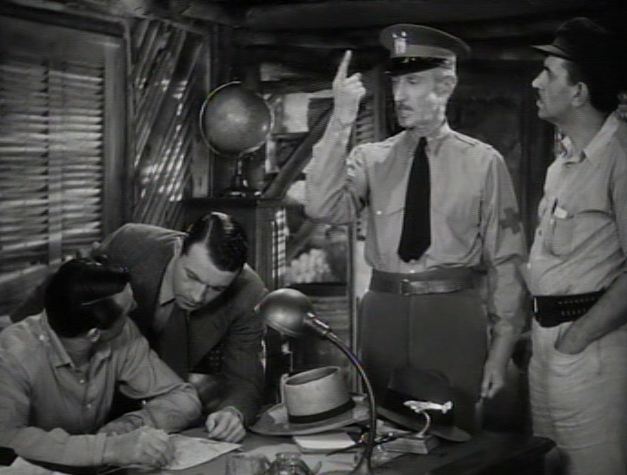
Barthlemess is great in this role, a man doomed by his own guilt, haunted and too self-punishing even to look for redemption. We look in his expressive dark eyes and maybe we recall the “The Dawn Patrol” (1933) and other hero roles not so many years ago, but seemingly a lifetime for this now middle-aged man.

Another element is keeping up the pace is the constant and subtle shifts into humor. There are glib remarks and pratfalls. The proud Spanish-speaking company doctor, played by Lucio Villegas, who Barthlemess is ordered to fly up to a mining camp to treat an injured man is insulted by the suggestion that it might be too dangerous, and spouts a soliloquy from Shakespeare about courage while Grant tries to placate him and shut him up.

Then there are the flying scenes that take us breathlessly up the mountain passes and across rugged terrain in a craft that looks like to be little more than a wood crate with wings. The aerial photography is spectacular. Though some of it is models, it’s all breathtaking action. At one point, Barthlemess must take off from a narrow cliff with not enough room to taxi, so he taxis the plane right off the ledge and picks up the wind currents on the drop, like a kite, in a stomach-turning descent.

It is these successful daring tasks and precise flying that earns Barthlemess Grant’s grudging respect. Eventually, however, Rita Hayworth (Judy, Judy, Judy) wants to know why her husband is always treated like dirt. She is still in the dark about his past. We have a reunion scene between the former lovers Hayworth and Grant, but we can see that there are no more sparks between them. Miss Hayworth is in love with her husband, and Mr. Grant is just as fed up with her as when she tried to tame him.

It would have been more interesting, I think, to have Grant and Hayworth still attracted to each other, then the foursome would really be caught in a dilemma; each would be forced into making decisions about their lives instead of just letting things happen.  Perhaps Howard Hawks felt he had enought subplots.

More humor when Grant catches the stumbling Jean Arthur eavesdropping on their conversation, and Jean slowly starts to enter the picture again, waiting out a nail-biting test flight of Grant’s that has her getting sick to her stomach. Again, comforted with kind words and a Bromo-Seltzer from Thomas Mitchell. She confides again her love of Grant to him.

“I know I’m a fool, but I can’t do anything about it,” she whimpers. She recognizes, and envies, Mitchell’s close relationship with Grant.

“You love him, don’t you, Kid?”

“Yes, I guess I do.”
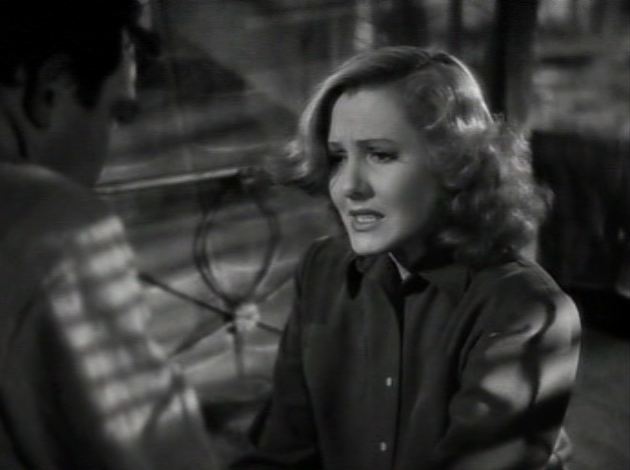
“Why can’t I love him the way you do, sneer when he tries to kill himself, be proud when he doesn’t? Why couldn’t I be there to meet him when he got back? What do you do when he doesn’t come back when you expect him to?”

Mitchell’s tortured expression and body English tells us there’s been many a time he got sick with worry over Grant. “I go nuts.”

Another comic, but sexy scene is when Jean Arthur sneaks into Grant’s room so she can use his bathtub. Grant enters, and they bristle and irritate, and flirt, and laugh. Rita pops in, and a terrific jealous exchange between her and Jean:

“Maybe I’d better go,” Jean offers.

“No, please don’t,” Rita replies, with raised eyebrows and an arch expression.

“I really didn’t intend to.”

But Rita is not really jealous, she’s affirmed that she loves her husband and will let the past go.

Another comic bit when Grant sees Arthur limping and he picks her up in her arms. She tells him she’s not hurt, she just broke the heel of her shoe.

“Imagine,” she says, “Losing one heel right after another.” They kiss, and she promises there will be no tying him down or asking him to give up flying.

“You don’t have to be afraid of me anymore.” What a line, as comforting as it is accusing. The screenwriter gives her more gold,

“There’s nothing I can do about it, I just love you. That’s all. I feel the same way about you the Kid does.”

It’s an honest assessment of his relationship with Thomas Mitchell, who puts a coat over Grant’s shoulders on a chilly night, brings him coffee and worries that he doesn’t get enough sleep, lights his cigarettes. (Everybody seems to light Grant’s cigarettes in this movie.) He does what he can do for his chum, then he wanders into the background. It’s the kind of relationship with which Grant is comfortable, and the only kind he can accept from Jean.

He’s still not a committing kind of guy, but something happens to open up a place on Grant’s dance card.

Yeah, a great big old cast iron spoiler here. Read on at your peril.

Another flight must be undertaken to meet a needed contract, but the only ones who can take this assignment are Barthlemess and Mitchell. Destiny takes a hand, and the man with the guilt, and the man with the hatred for the guilty party who got his kid brother killed are riding the skies together.

The plane runs into trouble, a fire on board, and they crash, but Barthlemess will not bail out this time. With superb flying, he brings the plane to the ground. He is badly burned, but Thomas Mitchell is fatally injured.

Afterwards, the fliers welcome Barthlemess into the fraternity and place a drink in his bandaged hands. Manuel Alvarez Maciste plays guitar and sings a sad Spanish tune that soothes and laments at the same time. Mitchell’s personal effects are laid out on the bar in a handkerchief. This time, Cary Grant does not cynically offer the goods to anyone. He takes the small bundle to his room to be alone with them.

It’s different with Mitchell. Nobody’s going to say, “Who’s the Kid?” at his death. Mr. Grant’s manly code of élan in the face of death does not extend to his dearest friend. Maybe he’s a hypocrite. Maybe he’s human. The men who call him “Papa” because he is their leader in their tight-knit male hierarchy will not see him cry, but Jean does.

Another smoothly comic bit when Jean, antsy and pacing outside Grant’s office just before she leaves for the boat meets with Victor Kilian again, who whispers to her,

“Aren’t you going to say goodbye to him? I think you ought to.”

Jean, surprised, clinging to hope, “You do?”

“I think he’d want you to.”

“You sure? I don’t mind doing it if you say so.”

“I do say so.”

“You do?”

With Kilian’s blessing, she enters Grant’s office, mumbling defensively that Kilian wanted her to.

It runs that knife edge between silliness and deeply touching.

She practically begs Grant to ask her to stay, but he vacillates. He wants her to stay, because he needs somebody. He’s just about to say something, when we hear from the radio once more:

“Calling Barranca! Calling Barranca!”

The weather clears, and there is one last chance to make their contract, so Grant scrambles to his plane. This time Jean’s plea has a disgusted, angry tone.

“I’m hard to get Geoff. All you have to do is ask me.”

He can’t, but he suggests they flip a coin, and it is not until after he leaves that she realizes it is Thomas Mitchell’s two-headed coin.

It’s the closest he can come to asking her to stay, and she does. We may wonder if she’s getting the short end of the stick staying with a man so emotionally close, or so proud, or so hurt, or so juvenile he cannot comfort her with a simple “I love you”. Maybe it’s because he doesn’t. If he’s inscrutable to Jean, he is to us as well.

But this is not a world of commitments, because commitment suggests the possibility of a future, and in Barranca we are only concerned with the here and now. There will be many hasty commitments made, clung to, and perhaps regretted during the war that will follow in only a few more months.

Does anybody else feel sorry for the guy in the mountain lookout post, all by himself through the entire movie? Played by Don “Red” Barry, poor “Tex” never gets any company, except his mule.

“Only Angels Have Wings” made such an impression of movie audiences of the day that “Calling Barranca!” was a punch line for a while. A few cartoons used the gag, including this one from Tex Avery’s “Ceiling Hero” (1940) and “Saddle Silly” (1941).


Perhaps some of you will remember the early 1980s TV show “Tales of the Gold Monkey” starring Stephen Collins. That was inspired by “Only Angels Have Wings”.

The banner year of 1939 gave us movies that were escapist in many ways, but inevitably truthful about who we were, and what we imagined about the world. Please have a look at the many other blogs participating in this blogathon. Special thanks to Becky of “Classic Becky’s Brain Food” and Page of “My Love of Old Hollywood” for organizing the fun.

Monday, 31 May 2010

Symbolism in Gone with the Wind


In “Gone with the Wind” (1939), when in the closing days of the American Civil War Scarlett O’Hara, played by Vivien Leigh, berates Melanie, played by Olivia de Havilland for feeding starving Confederate soldiers straggling home. Melanie relates that her husband Ashley was last known to be in a Northern prison camp…

“And maybe if he’s alive and well, he’s on some northern road right now, and maybe some Northern woman is giving him a share of her dinner and helping my beloved to come back home to me.”

Melanie’s typically sweet response reflects in some measure those Southern women who decorated the graves of Union soldiers after the war, which was the beginning of our Memorial Day. Today, we cover Memorial Day with a look at symbols in “Gone with the Wind.”

I have to warn you, this is going to be a long post. You might want to get a sandwich.

We’ve touched on Memorial Day and the Civil War as depicted in movies in previous posts on “Friendly Persuasion” (1956) and here on a compilation of Civil War movies. We noted particularly in this latter post that most Memorial Day television marathons show World War II movies. Since it was the American Civil War that gave us Memorial Day, it’s interesting to look at our film treatment of that war.

“Gone with the Wind” presents some interesting aspects of that era, especially of how that war has come down to us in symbols. Symbols are very important to us. They are stand-ins for deeper meaning or fuller explanation. A wreath on a soldier’s grave is a symbol. A Confederate flag is a symbol. We are still dealing with repercussions, not of the war, but of the war’s complicated aftermath when this flag first developed into a powerful symbol. The war’s aftermath constitutes most of “Gone with the Wind”.

Only last month, Virginia Governor Robert F. McDonnell (R) drew criticism when he issued a Confederate History Month proclamation that paid tribute to the state’s heritage as a member of the Confederate States of America, and omitted any mention of slavery. Gov. McDonnell explained that the proclamation was devoted to issues he felt were most "significant" to Virginia. The proclamation was requested by the Sons of Confederate Veterans.

He afterwards re-issued the proclamation with the additional paragraph:

WHEREAS, it is important for all Virginians to understand that the institution of slavery led to this war and was an evil and inhumane practice that deprived people of their God-given inalienable rights and all Virginians are thankful for its permanent eradication from our borders, and the study of this time period should reflect upon and learn from this painful part of our history…

It was admirable for him to correct the omission. Some may wonder how in this day someone might forget to mention slavery as a significant issue in the American Civil War. On the other hand, most of us by now have grown cynical with the knowledge that there are a vast number of people who dismiss facts which are uncomfortable for them.

However, part of this dismissing of facts, or at least of in-depth explanations, is due to our inevitable packaging of historical events in the form of convenient, no fuss-no mess symbols. These symbols are vivid, triggering instant recognition the same way corporate logos and commercial jingles are used. Sometimes they are used with the same purpose of “selling” an idea or image to us to trigger our acceptance and allegiance to that idea, the way commercials try to trigger our allegiance to a product.

Sometimes, however, we must fault our own laziness in teaching history this way, and our laziness in accepting history this way.

“Gone with the Wind” is a lush, lavish soap opera about survival, told through memorable characters and a dramatic backdrop of the Civil War and Reconstruction periods. It is excellent storytelling, and is a movie that many of us can watch again and again. Despite our familiarity with it, it remains captivating and enjoyable.

It is not an historical documentary. It is storytelling, and yet for many people it is possibly their introduction to the American Civil War, and perhaps even the sum total of their knowledge.

Plucking only a few symbols from this movie tells us a lot about our attitudes about the Civil War based on our ignorance.

When Scarlett receives a letter announcing the death of her first husband during the War, his commander writes, “Though Captain Hamilton was not vouchsafed a hero’s death upon the field of glory, he was none the less a hero, dying of pneumonia, following an attack of measles.” (For one thing, the penmanship is too modern to be 19th century style, but we’ll let that go.)

I can recall watching the film with others who chuckled at this, since it implies that goofy Charles Hamilton was a bit of a loser for dying in this unheroic manner. I believe probably the film’s famous producer, David O. Selznick, thought the same thing and so emphasized this frame of film where we see the letter with the flowery language and the irony of what is perceived to be an ignominious death.

However, most soldiers who died in the American Civil War died of disease, not battle wounds. We also might note that this is especially significant when we know that the battle deaths occurred in the thousands.

To put that into perspective, in the past seven years over 4,700 American service personnel have been killed in Iraq. As terrible a price that is to pay, in the four-year period of the American Civil War over 200,000 battle deaths occurred, North and South. The deaths due to disease were over 400,000, more than twice that of deaths due to battle wounds. About two-thirds of the over 600,000 military personnel who died in the Civil War died of illness.

Many battles resulted in a loss of 30 percent of the soldiers on the field. Thousands were mowed down in minutes. We could not, and would not, endure such statistics today. For deaths due to sickness to top that alarming rate is astounding.

So, Charles Hamilton’s sickbed fatality is not so worth smirking at after all. It is not a joke; it is a tragedy.

Another symbol we may address is the Confederate flag. One of the most striking scenes in the film is when Scarlett wanders out of the hospital to look for Dr. Meade, played by Harry Davenport. She walks out to the railroad yard where wounded men have been deposited and are awaiting treatment. As the camera pans back, we see her become smaller and smaller as she disappears into a sea of wounded men. Finally, the camera pans back far enough for us to have a bird’s-eye view, with a tattered Confederate flag snapping in the breeze in the foreground.

It is a wonderful symbol of pride being humbled by defeat in battle, of a proud young nation struggling to establish its identify under bleak circumstances.

But the so-called Confederate flag, that dramatic design of blue crossed bars on a red field, with stars for each Confederate state in the blue inverted cross, was never the flag of the Confederate States of America. It would never have flown in this manner from a town flagpole at the rail yard. It is a magnificent and stirring piece of symbolism, (movies love visuals) but it is the product of Hollywood imagination.

There were several flags of the Confederacy. The first was a blue flag with a single gold star, the so-called Bonnie Blue Flag, as in the song, “Hurrah, hurrah, for Southern rights, hurrah! Hurrah for the Bonnie Blue Flag that bears a single star!” It is also where the daughter of Scarlett and Rhett Butler, played by Clark Gable, got her name: Bonnie Blue Butler.

This flag was followed by other designs, mostly based on a variation of the United States flag. Here you can see an example behind Harry Davenport as he conducts the ball. Here again it is behind the bandleader who announces to the crowd they are about to play the Virginia Reel. The flag was nicknamed The Stars and Bars.

(The only thing more dashing than Clark Gable is Clark Gable dancing the Virginia Reel. The ball sequence contains a lot of symbolism to illustrate the gracious and elegant heritage of the planter class of the Old South.)

What we know today as the so-called Confederate flag was actually a square battle flag. Flag bearers marched out onto the field of battle along with their company of soldiers. The Stars and Bars appeared too much like the Stars and Stripes on the battlefield, so General P.G.T. Beauregard, Army of Northern Virginia, sought a different design after the First Battle of Bull Run (or First Manassas) to keep troops from being confused in battle and being the victims of friendly fire.

This design was created and was used in various versions for many battle flags for different fighting units of the Confederacy. Late in the war in 1865, part of this design was used in yet another new official flag of the Confederacy. Today part of this design is found on the flags of many southern states.

What makes people today recognize this flag as the Confederate flag is perhaps due to two circumstances. One, the South lost the war, and when devastation occurs it is usual for people to blame politicians first. It may be that the Stars and Bars, though revered as their nation’s flag early in the war, became a bitter reminder of a failed government of a country that no longer existed.

The South’s reverence was transferred from their government and their cause, to their veterans who had fought so bravely and so skillfully against incredible odds. They took the old Army of Northern Virginia battle flag design to their hearts as a symbol of the courage of their men.

A second circumstance is that this flag was early on adopted by the post-war fraternal group, the Sons of Confederate Veterans, that same, still active group which prompted Virginia Governor McDonnell to issue a Confederate History Month proclamation.

There were other circumstances that took root in the late 19th century and continued to blossom in the 20th: the Ku Klux Klan adopting this flag as their standard, as did many hate groups, Neo-Nazis and the like, whose reverence for a self-styled superior heritage is as twisted as their ignorance of the true history of this flag. Today the flag is still used in both ugly hate demonstrations, and also in completely innocuous venues. Neither use, however, either as threat or as an innocent gesture of regional pride, displays an accurate knowledge of the history of this flag.

But the symbolism that has come down to us, that symbolism which spurs us to instant recognition, is complex, mainly due to ignorance of how this flag was really used. To some today it will symbolize the Old South. To others, a rebellion against oppressive government. To others, it means racial domination.

General Beauregard only wanted a battle flag to keep his men from being fired upon by members of his own army in the confusion of battle.

The truth may not always set us free, but it can sometimes shed a light on things.

As for the above-mentioned Ku Klux Klan, this organization was also used by some as a symbol of righteous Southern men preserving their heritage and defending the honor of their women. Director D.W. Griffith famously brought enormous controversy upon himself when he depicted Klansmen as heroes in “Birth of a Nation” (1915), see previous post part 1 here and part 2 here.

GWTW delves into this vigilante-as-hero only a bit in the scene where Scarlett is attacked in Shanytown, and Ashley, played by Leslie Howard, and her second husband, Frank, played by Carroll Nye, along with a gang of other noble heroes of the gentlemen class, must “clean them out”. They set fire to the camp of indigents.

Union solider Ward Bond barks,

“A lot of those shantys were burned. A couple of men were killed. It’s about time you Rebels learn you can’t take the law into your own hands.”

It is mild castigation, and we may note that there is no further reference in the film to the Klan that would become famous as an underground group of terrorists whose sole purpose was to oppress African-Americans, Catholics, Jews, and foreign-born Americans. Hanging, along with mutilation, and setting fires to churches, was a favorite pastime. It might also be noted that the Klan enjoyed its zenith not in the immediate years following the war, but in the 1920s, only the decade before this film was made.

The Civil Rights Movement of the 1950s and 1960s did much to dispel the myth of respectability, and to shine a light on the hypocrisy of so-called respectable men who would see oppression of others as their path to righteousness, as an expression of their heritage.

But GWTW treads lightly on such racial issues, which is quite a trick to pull off. To be sure, the film is racist in its depiction of “good” blacks as being the servile ones. We have Gerald O’Hara, played by Thomas Mitchell, exhorting Scarlett to be firm but gentle with “inferiors.” We have the symbol of the well-dressed haughty (I believe the term back in the day would be “uppity”) black man singing “Marching Through Georgia” to insult the Southerners. We have the sharpster selling gullible ex-slaves on the “40 acres and a mule” slogan. All visual symbols strung together to be a kind of easy survey course in American history. No fuss, no mess, no in-depth explanation.

However, one can see a degree of sensitivity in Mr. Selznick’s helmsmanship. There are interesting clues to make one suspect he was fighting the good fight from behind the lines.

For instance, though Scarlett is attacked by ruffians, those ruffians were white men. The man who came to her rescue was Big Sam, played by Everett Brown, one of the former slaves on her family’s plantation.

In another scene, Big Sam and several other slaves are being marched through Atlanta, taken off their plantations by the Confederate army, to dig defense entrenchments. As they walk along, they ironically sing the spiritual, “Let My People Go.”

And though the African-American actors portray servile slaves, they nevertheless have their own distinct personalities. One of the great joys of this film is watching Hattie McDaniel holler at everybody.

She won a Best Supporting Actress award for her role, the first African-American actor to win an Academy Award. Her best scene is when she is slowly walking up the grand staircase with Melanie, weeping over the death of Bonnie, and explaining the tragedy to Melanie and to us. Her emotional breakdown is one of the most genuine scenes in this film. Here she is not a servile slave, she’s a heartbroken woman, and we feel her agony. She was a great actress, and this is obviously a scene David O. Selznick can be proud to have in his film, because the two actresses in it transcend being either black or white. It just doesn’t matter at that moment.

Prissy, played by Butterfly McQueen, may be empty-headed, but she inflicts her will in her own unique ways. However, the producer missed the opportunity to show the character Uncle Peter, played by Eddie “Rochester” Anderson in a better light.

This character is the slave of Aunt Pittypat Hamilton. Because Aunt Pittypat, played by Laura Hope Crews, is even more empty-headed than Prissy, in the novel this house servant with more sense than anybody actually runs the home. Uncle Peter decides when Melanie may put up her hair and go to parties, and when Charles may have a larger allowance, and he sends him to Harvard. In the movie, we only get to see Uncle Peter chasing a chicken in the rain. It does nothing for the dignity of the man we see in the novel.

One more scene I find interesting if only because I think it’s significant that it has been ignored, is when after the war Scarlett gives her deceased father’s gold pocket watch to their servant, now former slave, Pork. He tells her that she should sell it to pay taxes on the property, but she insists that she would rather give the watch to him, as he was her father’s devoted manservant for many years.

Pork, played by Oscar Polk, is choked up, and Scarlett replies, “Don’t cry. I can stand everybody’s tears but yours.”

There’s more going on here than Scarlett showing kindness. Vivien Leigh actually takes Oscar Polk’s hands in hers, places the watch in his hands. Then she briefly cups his hands in hers and pats them in a comforting manner.

It lasts only a moment, but consider, in the later years of the Civil Rights Movement, in 1968, after so much progress had been made changing the attitudes of bigotry, there occurred the famous incident between Petula Clark and Harry Belafonte. British singer Petula Clark hosted a television special with Mr. Belafonte as her guest star. At the end of one duet they sang together, she lightly touched his arm in an unthinking, friendly gesture.

A representative of the show’s sponsor, Chrysler-Plymouth, requested that gesture be edited out. He did not want to offend his southern market. A white woman touching a black man. Petula Clark, who owned the show, stood her ground and would not allow the gesture to be edited out.

Nearly 30 years earlier in GWTW, a British white actress touches a black actor in a similar gesture, in an era where this could have been a huge problem with the film distribution in the south. It could have so easily been edited out.

It was left in. Perhaps it drew no fire because the woman was supposed to be the mistress of the house, and the man was supposed to be the servant. It was still a white woman touching a black man with affection. I wonder if David O. Selznick knew what he got away with.

All kinds of symbols. We make too much of some; we make too little of others.

The most entertaining aspect of GWTW is Scarlett’s and Rhett’s survival instincts that carry them through so much. When the war is over, Scarlett’s active mind switches immediately from peace to profit:

“Ashley’ll be coming home. We’ll plant more cotton! Cotton ought to go sky high next year.”

She sees before anyone the need to shake off the old failed experiment of the Confederacy and live for the here and now. She sees her downtrodden, confused father shuffle bits of paper, and asks him what they are.

“Bonds. They’re all we’ve saved, all we have left.”

“What kind of bonds?”

“Why, Confederate bonds, of course, Daughter.”

She blows off his reverence both for his bonds and his Confederacy.

We might take a leaf out of Scarlett’s book, or rather, author Margaret Mitchell’s, when we consider the importance of landing on our feet economically. Margaret Mitchell related that she first began to learn the story of the South during the Civil War and Reconstruction when she was still a child and she played hooky from school. Her mother took her on a ride in the country, showing her dilapidated mansions and told her stories of people who could not, or would not adapt, how a whole society collapsed. She impressed upon her daughter the need for education and a sense of perspective, as much as the need for grit in a changing world. It left a seed in young Margaret’s mind.

David O. Selznick may have embroidered his film with flowery verbiage about “Cavaliers” and gallantry that is no more, “of a civilization Gone with the Wind…”, but Margaret Mitchell saw the less romantic and practical side of it, and that is what is most intriguing about the book, and most intriguing, when we see it, in the film.

Some have looked at the novel and the film as dismissing all that was abhorrent in the Old South, but Margaret Mitchell and all Southerners, white and black, deserve their pride of heritage. Margaret Mitchell, Governor McDonnell, and the Sons of Confederate Veterans included, none of us should feel defensive over the ways of our ancestors (especially to the point of diminishing the importance of certain facts), anymore than we have a right to take credit for their good deeds and achievements. Only what we ourselves do and say is what sticks to us. Let the past lie, but don’t kick dirt over it.

What we must all not allow is too much wallowing in symbols that don’t really mean what we want them to.

The American Civil War era was awash in contradictions. (Consider another brief scene in GWTW of a town band playing “Dixie” while the crowd waited for casualty lists after a major battle. The song so identified with the South was written by a Northerner for a minstrel show.)

The war was fought by southerners as a reaction to what they felt was a too-strong centralized government favoring northern interests. The main right they wanted to preserve was the right to own slaves, upon which their economy was based. When Abraham Lincoln was elected President, a man who promised only to limit slavery in new territories, not to abolish it, the southern states kicked over the checkerboard, scattered the checkers and decided they didn’t want to play anymore. The idea of separatism has always been appealing when frustration reaches its peak.

They weren’t the first to think of secession. New England wanted to secede over the War of 1812 because fighting with Great Britain was destroying their economy. Just after the Revolution, farmers in western Massachusetts erupted in Shays’ Rebellion as a response to what they felt were eastern merchants oppressing them economically. Such rebellions never end well, at least not in a nation where working together has always benefited us more. Our whole system is specifically designed to capture the benefits of compromise. Separatists, and special interest groups, should remember that.

It is remarkable to think that after the terrible hatred and violence of the American Civil War, some southern ladies decided to honor the graves of enemy soldiers by placing flowers upon them. By such simple and gentle measures are great nations reborn.

(For another angle on Northern and Southern reconciliation, have a look at my essay on Anne Sullivan and Helen Keller and The American Accent on my New England Travels blog.)

Next year marks the 150th anniversary of the beginning of the American Civil War when southern separatists attacked the United States military post at Fort Sumter. (The order to fire was given by the above-mentioned General Beauregard, who later gave us “the Confederate flag”.) We’ll be up to our eyeballs in symbolism. But I wonder if the anniversary will be as important to reviving interest in the Civil War as did the 100th anniversary commemorations in the early 1960s?

GWTW was re-released in theaters in 1961 just in time for the 100th festivities (again in 1967 in a 70mm stereophonic version). Now on DVD, I wonder if it will play any part in capturing the imaginations of a younger generation for the American Civil War? Or, perhaps for many the movie just seems to carry a greater impression of Hollywood in the 1930s than it does of the Old South.