Showing posts with label Richard Barthelmess. Show all posts
Monday, 16 May 2011
Only Angels Have Wings - 1939
“Only Angels Have Wings” (1939) is a quintessential film of 1939, I would suggest for two reasons. First, its “boys’ own adventure” type story of a band of mail flyers in South America would be the end of the Depression era adventures, the last bit of intrigue in a far away land before World War II, which would turn very young real-life fliers into men under horrific circumstances. The aimless flyers in “Only Angels Have Wings” haven’t any such worries. They are not responsible for a nation’s freedom. They can’t even be responsible for themselves.
Somewhere out there in the tropical mist, we are on the cusp of a more treacherous world, a more grown up world. One gets the feeling Cary Grant is trying to hold it off as long as possible.
The second element that makes this movie such a prime example of 1939 is the presence of character actor Thomas Mitchell, who played in five of the top movies that golden year, all winners. Besides this one, he was in “The Hunchback of Notre Dame”, “Gone with the Wind”, “Mr. Smith Goes to Washington”, and “Stagecoach”, for which he won the Oscar for Best Supporting Actor. It’s not a 1939 film without Thomas Mitchell.
For classic movie buffs, 1939 has always been regarded as the banner year, when the Hollywood movie factories churned out on their assembly lines a greater than usual number of excellent films. This post is part of the Classic Movie Blog Association “Classic Films of 1939 Blogathon” which runs from May 15th through the 17th. Have a look here at the website for a listing of bloggers and their 1939 films. Looks like a lot of great reading.
In this essay, I’d like to look at “Only Angels Have Wings” through the prism of 1939 and not so much about what we know about that year, but what we may have forgotten about it. The biggest thing we often forget is that we’re watching current events. This film marks the end of a timeline in an era, though I rather imagine director Howard Hawks, himself a former flier, would not have recognized that when he made it. It had only been some 12 years previous to the making of this movie that Charles A. Lindbergh, “Lucky Lindy” flew the first non-stop solo flight across the Atlantic Ocean. That generation of seat-of-the-pants fliers like Lindy and Amelia Earhart, the Granville Brothers, and Bessie Coleman, were still part of the American popular culture; though some of them had already been killed in their daring exploits. These were still the days when airplane flight brought out the press and the newsreels cameras, where records made for huge headlines and parades.
Most people alive in 1939 could remember a time when there were no airplanes.
A week or so after “Only Angels Have Wings” premiered in May 1939, an unusually large number of the original cast, including Cary Grant, Jean Arthur, Richard Barthlemess, Rita Hayworth, and Thomas Mitchell, and even some original actors in very minor roles, appeared in a radio script version broadcast by the Lux Radio Theater. Have a listen to the show here, now in public domain, at the Internet Archive site. Scroll down the year 1939 until you get to May 29th.
Between the 2nd and 3rd acts, the show’s producer and host, Cecil B. DeMille, interviewed on radio hookup from New York City the captain of the “Yankee Clipper” that had just that week made headlines by inaugurating the first commercial airline service from the United States to Europe. This was not a movie stunt, this was real life. The four propeller engine plane held a crew of 14 and could carry 74 passengers, and the mail. The captain announced, “That means we have at last conquered the Atlantic.” The flight took 25 hours.
Here is a newsreel of the event (Remember to scroll down to the bottom of the page to mute the music so you can hear the video):
The world suddenly got smaller, and inter-continental travel got easier (if you consider a 25-hour flight in a propeller plane easy). “Only Angels Have Wings”, is a product of this world where pilots were regarded as daredevils and pioneers, not yet corporate executives or administrators.
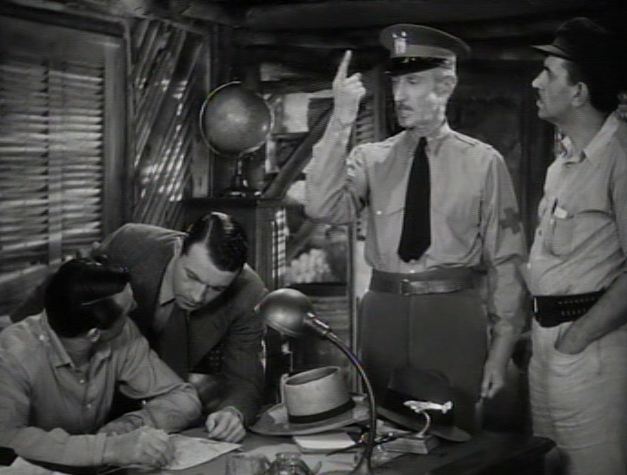
There is an inherent comic book feel to this movie, though again, I’m sure Mr. Hawks did not intend that. Consider how the pilots wear their holstered side arms below the belts of their high-waisted pants, their cuffs rolled up to show their boots. Black leather jackets with faded World War I insignia, and broad-brimmed straw hats to suggest a rakishness that is permissible in a area of law by mutual consent, opportunities built on enormous risks, too much liquor and a few carefully chosen (by the director, at least) women. Except for these last two points, we might be watching a film version of the popular comic strips “Terry and the Pirates” or “Smilin’ Jack”.
Here in this world of rattan shades and bamboo furniture, tropical birds and strumming guitars, Cary Grant is boss of a fledging airline running mail from a small port city of Barranca (you know you want to say it. Go ahead: “Calling Barranca, calling Barranca!”) to villages and mining camps far up the Andes. We are in South America, and the only premonition we get of the war to come is the Latin American music, which will have a huge impact beginning in the next year when after war broke out in Europe, we strengthened military and commercial ties with Latin America. The samba and the rumba were not far behind.
Jean Arthur stumbles into Barranca off a tramp steamer one tropical night that delivers a handful of passengers, and cargo, and mail for the plane. She is a piano player, who has left her last troupe of entertainers in Panama. She’s on her own, as free, or as lost, as the men she encounters in the base camp run by Dutchy, played by Sig Ruman. Most of the action of the film takes place in his bar/restaurant/hotel/air field. It is almost like Rick’s Café Americain in “Casablanca” only without the Nazis, or the refugees.
“Casablanca”, despite being almost entirely confined to Rick’s, gives us a closer look, and better acquaintance with the local setting and people. “Only Angels Have Wings” gives us only a brief look at the locals, when Jean Arthur enters another saloon that seems to cater only to them, and enjoys, and sings along with, vibrant Spanish music and dance. She is courageous enough to explore and appreciate. Cary Grant and his boys only buy drinks for, and we assume, sleep with, local girls from time to time. They don’t bother with the local culture too much. Their clubhouse is an island unto itself. Like Peter Pan's Island of Lost Boys. An American 1939 fantasy. When Mr. Grant reaches into his wallet to donate money to the sister of a killed pilot, he offers American greenbacks. In a country where U.S. currency is not used.
Two happy go lucky fliers chat up Jean and bring her to their clubhouse for drinks and steaks, and take turns flirting with her. One, played by a young Noah Beery, Jr., is sent by the boss, Cary Grant, on a late night mail run, but there is bad weather and he returns in a risky landing. The film is barely ten minutes old and we have a ghastly crash while Grant, Miss Arthur, and Grant’s best pal, Thomas Mitchell look on, horrified.
Jean Arthur, sassy and street smart, is crushed by this tragedy, and finds herself equally exasperated with, and attracted to, flippant Cary Grant. In matters of everyday living she is in firm control and nobody’s fool, but in love…she is utterly helpless.
Mr. Grant plays the cynical, smart aleck leader. It would be interesting to have seen Humphrey Bogart in the role, to have his calm stoicism play against a jittery Jean Arthur. He would have given the character a soulfulness, a back story of pain and hard luck just in his glance. Bogie always walks in the door with his own back story, the way some actors might show up for auditions with their own costumes. Despite his facade of danger, he has a code of honor, while Cary Grant has no such nobility. He is really a condescending rogue. He sizes up Jean Arthur with the taunting remark, “Chorus girl?”
But Cary Grant, as handsome as it gets and just coming off his hero-adventurer stint in "Gunga Din" (1939) is right for the role in his charm, his boyish devil-may-care attitude, and especially his under-the-surface neediness. (And Bogart had not yet reached his "hero" stage; he was still a thug in 1939.)
Some reviewers have suggested over the years that Grant was miscast in this role, but I disagree. It's true that he had not yet reached the maturity of his later roles where he was able to play a mysterious, cool man of action, as in "North by Northwest" (1959) or "Charade" (1963). It is also true that at times in "Only Angels Have Wngs" his character seems just a little too forced into the straightjacket of Howard Hawks' alpha male: his fastitious pseudo-macho shirt collar always buttoned at the neck to a half-standing position, the self-consciousness of his growling speech and movements. There is no back story to read in his face and his manner, the way we can with Richard Barthlemess and all the other minor characters. It is as if at times the handsome veneer is vacant.
At this stage of his career, he was much better suited to the charming scamp, con artist roles, such as with his other Hawks' film of the time, "His Girl Friday" (1940). Still, Grant in this role of the leader of this band of fliers is fun to watch, and he pulls off something that I don't think any other male star of his day could do as well.
There is an inkling of brittleness to his bravado that is intriguing. He talks a great game of fatalistic acceptance of risk and death, but he clings to Thomas Mitchell as his chief emotional burden and his greatest friendship, for whom he takes heartsick responsibility and from whom he receives love and understanding he gets from no one else…until Jean Arthur comes along.
She is the lone woman who infiltrates the boys’ clubhouse. She says “Down the hatch” when she drinks her bourbon with Noah Beery, Jr. and Allyn Joslyn (for more on Allyn Joslyn, have a look at Caftan Woman’s recent post here), but she’s still a lady. She bristles at being passed along, and at being taken for granted. Eventually, she starts to blend in with the boys, after Cary Grant has shaken her, physically as well as emotionally, bawling her out for bawling the boys out when they display no mourning over the death of the flyer Joe Souther.
“Who’s Joe?” they scoff.
In a sweet bit of consoling, which is reprised later in the film, Victor Kilian, who plays the radio operator “Sparks”, confesses he got the same treatment when he was a newbie. Jean unburdens herself to the gentle, sad-faced Mr. Kilian,
“You know, all my life I’ve hated funerals. The fuss and bother never brings anybody back and it just spoils remembering them as they really are. And when I see people actually facing it that way, I act like a sap.”
She remembers the pain of her father’s sudden, violent death. She is alone in the world and so she grabs onto life with both hands, traveling by herself, not fearing to explore, or expose herself to emotional commitment. She is braver than Mr. Grant in this respect.
To make amends for her “unmanly” outburst of grief at Joe’s death, she wanders back into the bar and interrupts a jam session at the piano, taking over the keys herself, and banging out Sophie Tucker’s old theme song “Some of These Days”. Jean Arthur actually looks like she’s playing the piano here; she fakes it well. Most stars tinkling the ivories for a film role usually looked like they are mixing meatloaf with their hands.
Here’s the clip:
“Who’s Joe?” Grant tests her.
“Never heard of him.”
Later, alone at the piano as the bar empties out, she begins the leaden strains of “Lebestraum”, but catches herself before she gets too maudlin. Joe’s personal effects are brought in, only a handful of trinkets, and Cary Grant, per their ritual, allows anyone to take what they want. He offers the trinkets to Jean, and she takes a watch, the most expensive thing.
“You’ve got a good eye,” Grant sneers at her, insinuating that she is just a gold-digging chorus girl after all.
She gives him a look of disgust and mutters in a low voice, just short of growl, “Say, somebody must have given you an awful beating once.” It’s as good a putdown as anybody ever gave to Grant, and as truthful. He begins to change his opinion of her, for her honest challenge, and because she immediately gives the gift to the local girl who grieves the most for Joe. Grant is rebuffed, and impressed.
Miss Arthur is not far from the mark when she suggests someone has treated him badly. We get his version of a former love who tried to ground him with her possessiveness. It is also a warning to Jean not to try to do the same. He invites her to his room, and she accepts, but then he steers her out the door back to the boat. It’s a teasing game, and he blinks first. But when the fog clears and he must take the next mail plane out, he grabs her in a hasty kiss, and she is hooked. We know this, because she’s still there when he returns in the morning.
He irritably puts her off again, and she questions her own mixed up feelings and lack of judgment, “I don’t know whether this is me or another fella.”
Only Jean Arthur could say a line like that and be believed, just like she’s probably the only actress who can use interjections like “Hey!” “Say!”, “Gee whiz!” and “Jeepers” and have it sound profound.
There’s nobody that does that uncomfortable, “caught in the act” look quite like Jean.
But Grant is chafing over this clingy female, and the fear of commitment, and he demands she take the next boat, which won’t come until next week because, “Yes, they have no bananas” as Thomas Mitchell points out. Grant stomps away, and Jean is embarrassed and crestfallen.
“I’ve never quite made such a chump of myself.” Fortunately, Grant’s buddy becomes her buddy and he comforts her. Too bad she didn’t fall in love with Thomas Mitchell. (During the Lux Radio Theater broadcast of “Only Angels Have Wings”, Mr. DeMille thanked Jean Arthur and Thomas Mitchell for taking a week off from their current filming of “Mr. Smith Goes to Washington” to do the radio show.)
The movie shifts gears and we have the introduction of Richard Barthlemess, last seen here in “Heroes for Sale” (1933), as a new flier with a fake name and a mysterious past. Rita Hayworth is his pretty young wife. She doesn’t know that years before he piloted a plane that was going down in flames, and he bailed out, leaving his mechanic on board to die. Ever since then he has been shunned by other fliers.
He doesn’t know that she is Cary Grant’s former lover.
The subplots of this movie keep the pace moving nicely. Another subplot is Thomas Mitchell’s fading eyesight, which prompts Cary Grant to ground him. Mitchell is noble about it, accepting. Gut-wrenching tension between one who has to give bad news, and another who has to hear it. When Mitchell leaves, Grant boots a chair across the room in an explosive gesture, demonstrating only to us how badly he feels.
The mechanic who died in Richard Barthlemess’ plane was Thomas Mitchell’s younger brother. When Mr. Barthlemess is found out, he is shunned here, again, by these pilots, as he always is wherever he goes from job to job. He withstands Cary Grant’s barbs with stoic, self deprecating sarcasm, but Grant offers him a few dangerous jobs one else will take to earn his boat passage out of here. Including flying nitroglycerin, which he drops on condors.
Barthlemess is great in this role, a man doomed by his own guilt, haunted and too self-punishing even to look for redemption. We look in his expressive dark eyes and maybe we recall the “The Dawn Patrol” (1933) and other hero roles not so many years ago, but seemingly a lifetime for this now middle-aged man.
Another element is keeping up the pace is the constant and subtle shifts into humor. There are glib remarks and pratfalls. The proud Spanish-speaking company doctor, played by Lucio Villegas, who Barthlemess is ordered to fly up to a mining camp to treat an injured man is insulted by the suggestion that it might be too dangerous, and spouts a soliloquy from Shakespeare about courage while Grant tries to placate him and shut him up.
Then there are the flying scenes that take us breathlessly up the mountain passes and across rugged terrain in a craft that looks like to be little more than a wood crate with wings. The aerial photography is spectacular. Though some of it is models, it’s all breathtaking action. At one point, Barthlemess must take off from a narrow cliff with not enough room to taxi, so he taxis the plane right off the ledge and picks up the wind currents on the drop, like a kite, in a stomach-turning descent.
It is these successful daring tasks and precise flying that earns Barthlemess Grant’s grudging respect. Eventually, however, Rita Hayworth (Judy, Judy, Judy) wants to know why her husband is always treated like dirt. She is still in the dark about his past. We have a reunion scene between the former lovers Hayworth and Grant, but we can see that there are no more sparks between them. Miss Hayworth is in love with her husband, and Mr. Grant is just as fed up with her as when she tried to tame him.
It would have been more interesting, I think, to have Grant and Hayworth still attracted to each other, then the foursome would really be caught in a dilemma; each would be forced into making decisions about their lives instead of just letting things happen. Perhaps Howard Hawks felt he had enought subplots.
More humor when Grant catches the stumbling Jean Arthur eavesdropping on their conversation, and Jean slowly starts to enter the picture again, waiting out a nail-biting test flight of Grant’s that has her getting sick to her stomach. Again, comforted with kind words and a Bromo-Seltzer from Thomas Mitchell. She confides again her love of Grant to him.
“I know I’m a fool, but I can’t do anything about it,” she whimpers. She recognizes, and envies, Mitchell’s close relationship with Grant.
“You love him, don’t you, Kid?”
“Yes, I guess I do.”
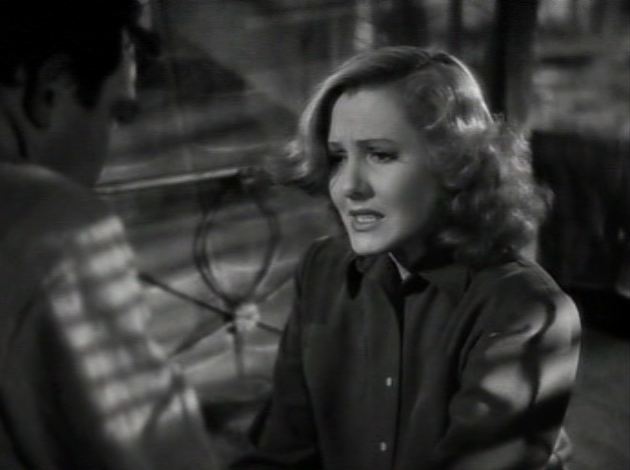
“Why can’t I love him the way you do, sneer when he tries to kill himself, be proud when he doesn’t? Why couldn’t I be there to meet him when he got back? What do you do when he doesn’t come back when you expect him to?”
Mitchell’s tortured expression and body English tells us there’s been many a time he got sick with worry over Grant. “I go nuts.”
Another comic, but sexy scene is when Jean Arthur sneaks into Grant’s room so she can use his bathtub. Grant enters, and they bristle and irritate, and flirt, and laugh. Rita pops in, and a terrific jealous exchange between her and Jean:
“Maybe I’d better go,” Jean offers.
“No, please don’t,” Rita replies, with raised eyebrows and an arch expression.
“I really didn’t intend to.”
But Rita is not really jealous, she’s affirmed that she loves her husband and will let the past go.
Another comic bit when Grant sees Arthur limping and he picks her up in her arms. She tells him she’s not hurt, she just broke the heel of her shoe.
“Imagine,” she says, “Losing one heel right after another.” They kiss, and she promises there will be no tying him down or asking him to give up flying.
“You don’t have to be afraid of me anymore.” What a line, as comforting as it is accusing. The screenwriter gives her more gold,
“There’s nothing I can do about it, I just love you. That’s all. I feel the same way about you the Kid does.”
It’s an honest assessment of his relationship with Thomas Mitchell, who puts a coat over Grant’s shoulders on a chilly night, brings him coffee and worries that he doesn’t get enough sleep, lights his cigarettes. (Everybody seems to light Grant’s cigarettes in this movie.) He does what he can do for his chum, then he wanders into the background. It’s the kind of relationship with which Grant is comfortable, and the only kind he can accept from Jean.
He’s still not a committing kind of guy, but something happens to open up a place on Grant’s dance card.
Yeah, a great big old cast iron spoiler here. Read on at your peril.
Another flight must be undertaken to meet a needed contract, but the only ones who can take this assignment are Barthlemess and Mitchell. Destiny takes a hand, and the man with the guilt, and the man with the hatred for the guilty party who got his kid brother killed are riding the skies together.
The plane runs into trouble, a fire on board, and they crash, but Barthlemess will not bail out this time. With superb flying, he brings the plane to the ground. He is badly burned, but Thomas Mitchell is fatally injured.
Afterwards, the fliers welcome Barthlemess into the fraternity and place a drink in his bandaged hands. Manuel Alvarez Maciste plays guitar and sings a sad Spanish tune that soothes and laments at the same time. Mitchell’s personal effects are laid out on the bar in a handkerchief. This time, Cary Grant does not cynically offer the goods to anyone. He takes the small bundle to his room to be alone with them.
It’s different with Mitchell. Nobody’s going to say, “Who’s the Kid?” at his death. Mr. Grant’s manly code of élan in the face of death does not extend to his dearest friend. Maybe he’s a hypocrite. Maybe he’s human. The men who call him “Papa” because he is their leader in their tight-knit male hierarchy will not see him cry, but Jean does.
Another smoothly comic bit when Jean, antsy and pacing outside Grant’s office just before she leaves for the boat meets with Victor Kilian again, who whispers to her,
“Aren’t you going to say goodbye to him? I think you ought to.”
Jean, surprised, clinging to hope, “You do?”
“I think he’d want you to.”
“You sure? I don’t mind doing it if you say so.”
“I do say so.”
“You do?”
With Kilian’s blessing, she enters Grant’s office, mumbling defensively that Kilian wanted her to.
It runs that knife edge between silliness and deeply touching.
She practically begs Grant to ask her to stay, but he vacillates. He wants her to stay, because he needs somebody. He’s just about to say something, when we hear from the radio once more:
“Calling Barranca! Calling Barranca!”
The weather clears, and there is one last chance to make their contract, so Grant scrambles to his plane. This time Jean’s plea has a disgusted, angry tone.
“I’m hard to get Geoff. All you have to do is ask me.”
He can’t, but he suggests they flip a coin, and it is not until after he leaves that she realizes it is Thomas Mitchell’s two-headed coin.
It’s the closest he can come to asking her to stay, and she does. We may wonder if she’s getting the short end of the stick staying with a man so emotionally close, or so proud, or so hurt, or so juvenile he cannot comfort her with a simple “I love you”. Maybe it’s because he doesn’t. If he’s inscrutable to Jean, he is to us as well.
But this is not a world of commitments, because commitment suggests the possibility of a future, and in Barranca we are only concerned with the here and now. There will be many hasty commitments made, clung to, and perhaps regretted during the war that will follow in only a few more months.
Does anybody else feel sorry for the guy in the mountain lookout post, all by himself through the entire movie? Played by Don “Red” Barry, poor “Tex” never gets any company, except his mule.
“Only Angels Have Wings” made such an impression of movie audiences of the day that “Calling Barranca!” was a punch line for a while. A few cartoons used the gag, including this one from Tex Avery’s “Ceiling Hero” (1940) and “Saddle Silly” (1941).
Perhaps some of you will remember the early 1980s TV show “Tales of the Gold Monkey” starring Stephen Collins. That was inspired by “Only Angels Have Wings”.
The banner year of 1939 gave us movies that were escapist in many ways, but inevitably truthful about who we were, and what we imagined about the world. Please have a look at the many other blogs participating in this blogathon. Special thanks to Becky of “Classic Becky’s Brain Food” and Page of “My Love of Old Hollywood” for organizing the fun.
Thursday, 11 November 2010
Heroes for Sale - 1933
We mark Veterans Day today with the film “Heroes for Sale” (1933), which was produced in that era when Veterans Day was Armistice Day and the prevailing view of Armistice Day and World War I was pacifist. By the end of the decade, war returned and pacifist sentiments would be something akin to treason.
Gone finally, or overwritten at least, was that era, not innocent, but world weary, when the loss and the futility of war was still felt so keenly. Richard Barthelmess shows the many sides of being a veteran. This is not so much a welcome home story as it is a what do you do now story. We begin in the trenches, and we end on a long lonely road to nowhere.
Richard Barthelmess and Gordon Westcott are part of the platoon that is engaged in a raid on the enemy. We are with them in the mud soaked trenches. We crawl along the barbed wire of No Man's Land in the night, in the pouring rain with cannon fire all around us. Mr. Westcott perhaps reflects our sentiments more purely when he has a panic attack and refuses to continue. He hides in the trench, while Mr. Barthelmess moves forward and captures the enemy. He brings the German officer back to the trench, a valuable prisoner to be interrogated. But just after he gets the German officer to safety, Barthelmess is shot and collapses.
Westcott brings the German officer back to headquarters and is proclaimed a hero. This is a film that could have been divided into two or three different movies, because there's a lot happening that is very interesting in terms of the illustrating great demons we carry around. Mr. Westcott is a perfect case study. He is a poster boy for that old line from Shakespeare’s “Julius Caesar”, “cowards die many times before their deaths; The valiant never taste of death but once.” Westcott’s fear at being found out dogs him this entire movie.
The first time we think he might be exposed is when the German officer is being interrogated in German by an American officer, and the German glances at Westcott with a wry, mocking smile, as if he knows that this coward, who did not capture him, is getting the credit for being a hero. We wonder if the German will tell. Westcott suffers agonies wondering.
There are several times when someone could spill the beans and Westcott’s dirty secret will be out, which lends a great deal of dramatic tension as we wait for his inevitable humiliation. It also reminds us throughout the film that the War, and its various consequences, is never over for these vets.
Meanwhile the valiant that taste of death but once, Barthelmess, we discover is not dead. Westcott thought he was and we thought he was, but he was captured by Germans and he was brought to a hospital behind enemy lines.
Here we see another aspect in a war movie that we would not see again for many, many years, and that is a humanistic, if not exactly empathetic view of the enemy. We see the Germans have their hospital and they treat the enemy as they would their own soldiers. They are not the monsters we seen the World War I posters. They are overburdened and overworked and desperately trying to save lives.
After the Armistice there is a prisoner exchange, and the German officer in charge of the hospital tells Barthelmess that he may go home. He gives him morphine to take because Barthelmess still has slivers of schrapnel in his spine which causes him great pain. Barthelmess is thankful, respectful, and they part like gentlemen.
We see what is probably a newsreel shot of a troopship coming home. Here, Westcott meets up with Richard Barthelmess again unexpectedly. The sick expression comes over Westcott’s face and he knows that he will have to come clean with this secret he carries, if not with the world, at least with Mr. Barthelmess. He confesses what he did, but Barthelmess has a nonchalant attitude towards it and lets him off the hook. He doesn't care. He says, “I've been in the shadow of death so long. Nothing seems very important anymore.”
It is an admirable sentiment and probably common to most soldiers after seeing absolute hell. They've seen the worst in they are not looking for the best anymore, just a little peace.
In a cameo role on this troopship we see James Murray, who we last saw in this post on “The Crowd” (1928). We mentioned the unfortunate circumstances of both his career and his life that took place a few years after this film was made. Since “The Crowd” was a silent movie, this film is the first time I've heard him speak. I was surprised to hear he sounds something like George Brent.
Westcott the hero goes home to a hero's welcome and Barthelmess goes home with a dependence on morphine. Westcott is a rich boy; his father owns the bank. Barthelmess works as a teller, and we see him behind the bars of his teller's cage looking for all like he is in jail.
He is struggling at work, he needs a fix, and he sneaks out of the alley to see the drug pusher. But the pusher has raised his prices, and Barthelmess can't afford it. We think for a moment that he might steal from the bank, but he doesn't. He goes to a doctor and the doctor reports him to the public authorities. His boss is unsympathetic. When Westcott tries lamely to defend Barthelmess the boss says, “You fellows forget the war is over. It's time to quit beating the drum and waving the flag.” The boss wants to fire him for his “loathesome cowardly habit”.
We see how these words sting his son, who is the real coward. Barthelmess finally does hysterically spill the beans when he is cornered, about the son’s cowardice, defending his drug habit by saying he got wounded while his son did nothing.
For a moment we think Westcott is finally exposed, but his father won’t believe the accusation. Westcott won’t admit to it, either. He dismisses Barthelmess’s words as the “ravings of a dope fiend.”
Barthelmess is sent to the state narcotics farm for several months. When he is released, we see by his file card that his morphine habit is cured, and we see from Barthelmess’ stroll around the cemetery that his mother has died in the meantime.
Now he heads to Chicago for a new start, and now we have what could be a completely different movie. Some aspects of this film are very similar to Paul Muni's experiences in “I Was a Fugitive from a Chain Gang” (1932). One could make a lot of comparisons.
In Chicago, Aline MacMahon, who we last saw as a chorus girl in this post on “Gold Diggers of 1933”, and her father, Charley Grapewin, run a small hole-in-the-wall diner and a rent rooms upstairs. Aline is her usual sharp but nice girl with snappy dialogue and a heart of gold. A plain Jane in whom no one is interested romantically, but probably should be. When Barthelmess comes in asking for a room, she brings him upstairs and tests the mattress out for him by vigorously bouncing on it, while Barthlemess watches incrediously in one of those naughty/innocent moments.
Loretta Young, with her large pale eyes and enormous smile also rooms here, Barthelmess, no surprise, is smitten by her. Another roomer is a German Communist, played by Robert Barrat who was probably one of the funnier people in this movie.
He is one of the gang here, and he always rants about the doctrines of servitude in a capitalistic society. But nobody dislikes him for his political leanings; they take him with a grain of salt. He is an equal here, even if he is a “Red”. They see him only as an obnoxious loudmouth. He could be just a minor character in this movie, but he actually ends up having a pivotal role. Cleverly though, his presence is meant more for comic relief rather than to nail the audience on the head with a social message.
Loretta works in a laundry, and Barthelmess gets a job there. He starts at the bottom and works his way to the top. Grant Mitchell is his boss.
Life is good for a while for our Mr. Barthlemess, coming home to the rooming house where the gang, who have become like a family, await him. Especially Aline MacMahon, whom pa Charley Grapewin teases for looking like she’s primping for Barthlemess.
She says no, “just trying not to look like the family”. A great line, and a great delivery.
In a bittersweet scene, Loretta and Barthelmess are preparing to go out on the town and they ask Aline to come with them. She is excited about going out, leaving the drudgery of running the place and looking after pa for a few hours to be with people her own age.
She goes off to get her hat and coat, but she sees Barthelmess and Loretta hugging, and she closes her bedroom door in a private moment of agony, being tactful and noble and crushed all the same time. Three is a crowd. She tells them to go on without her, and we see that not only has she lost what she thinks might have been a romantic relationship with Barthelmess, she has lost their companionship as well. Miss MacMahon is very good, very subtle in this scene. She is clearly one of those actresses who can do a whole lot with very little. The director lets the camera linger on her while she works through her emotions.
Loretta and Barthelmess marry and they have a little boy. Barthelmess is a success in business. Communist Mr. Barrat, who is an engineer, invents a machine to use in the laundry business. It will increase production. He comes to Barthelmess for help to promote and to get investors. Both see this wonderful machine as a benefit for employees. They will have more leisure time, and their work will be easier. They sell this machine to Grant Mitchell, and he agrees that no one will be fired, no salaries will be cut. A little Depression-era message.
But the illusion of utopia is shattered when a new owner takes over and does what new owners do: fires employees because who needs them with this great new machine?
We get a shot of the factory. There are few people at work, and those that are working at menial jobs, which do not require their intelligence or their creativity. They push buttons.
A riot of unemployed workers breaks out. I've read where director William Wellman hired real hobos for the fight scene, which one can believe because it is very realistic. There is one shot of Loretta Young, trying to struggle her way through the crowd looks as if she's in real danger. Barthelmess tries to stop the riot. Loretta gets beaten and trampled to death in a shocking scene of implied violence hidden by some quick cuts. Several others are killed, and Barthelmess is sent to jail for five years for being an agitator.
Good old dependable Aline MacMahon takes his son and raises him and tells him his father is in Alaska. There is a sweet goodbye scene when the little boy, sitting on his lap playfully pokes Barthelmess's tear-streaked face. When Barthelmess is taken away by the police and the child comes fretful, Aline tells the little boy soldiers don't cry.
They don't get much of a break, either. After five years, Barthlemess is released, but in the meantime, the Communist has sold many of his machines to many laundries and has gotten filthy stinking rich. He doesn't care if people are being thrown out of work because of his invention. He's made an amazing and humorous change. He turns from Communist to capitalist.
Conversely, Barthelmess's conscience is weighed down by the idea of people being thrown out of work. But the Communist has proven a valuable and trusty steward, because he saved Barthelmess’ royalties for him in a bank account, and now Barthelmess has a nice nest egg for the rest of his life.
They do a nice job aging Barthelmess. He looks haggard, not so baby faced when he was a young soldier out of the trenches. It's not too much or overdone, but you can see the lines in his face, the dark circles under his eyes.
The Communist is now wearing a millionaire’s tuxedo and derby, and attending University Club suppers. All this time Aline has been taking care of the boy. And now it is the Depression, and she and Charley Grapewin run a soup kitchen. When they run out of soup, and they must close the door to the next people in line, men and women, old folks stare desperately through the window.
Barrat calls them lazy moochers. Barthelmess gives Aline his bankbook and tells her to run her soup kitchen with his money. But the Communists has no use for charity. He says it is like a snowball that keeps growing and growing. If you feed them once they will always return. He says, “If I was running the world I would kill anybody that needed anything.”
This character has made the most amazing transformation in the history of the movies since Scrooge became a good guy. Communist, to capitalist, to fascist. A little more movie message here, but couched in clownishness.
Barthelmess, an ex-convict now smeared as a Red for having been involved in the labor riot, becomes the target of vigilante squads, self-important bullies with too much time on their hands, who run him out of town and grab a few Italians, too, because most likely they are Reds. Proof is not essential when you hate.
Barthelmess leaves Chicago, and like many other hobos in the Great Depression, rides the rails from one hobo jungle to another. In one he meets up again with Gordon Westcott. The “hero” is just out of jail for bank fraud, and his father who had been stealing from the bank for years, has shot himself to avoid prosecution. Westcott explains his father's thievery “is just one of those things. When you start, you can't stop.” It is ironic, and we think of Barthelmess’ drug habit long ago.
Ward Bond has a small cameo as one of the hobos in the jungle. It is rainy and muddy, just like when they were in the trenches years ago. The end of the movie is like where they began. Westcott still carries on his shoulders the guilt of his cowardice. But Barthelmess no longer cares, and if Westcott ever gains any absolution it is in the way his long ago human act of fear no longer matters in a world where even the World War no longer matters.
Westcott glances around, the rain dripping off his battered fedora, and mumbles, “This country can't go on this way. It's the end of America.” How many times have we heard that?
But Barthelmess, though not exactly an optimist, has a more fatalistic and practical approach. He brings up FDR's inaugural address (President Roosevelt was just beginning his first term when this film was released), and thinks things will iron themselves out in the end. He thinks America will come back stronger than ever.
And when the police raid their hobo jungle and move them on farther down the road, Barthelmess looks up and notes happily that it has stopped raining. He has a soldier’s fatalism, the kind you get when you've seen the worst. And you don't expect the best anymore, just a little comfort will do.
As the movie ends, we look into the eyes of his son. A boy who idolizes his father, a distant figure who supports the soup kitchen where Aline is raising him. We look into the eyes of the future. He says he wants to be just like his dad.
We know he probably won't be, because the circumstances of his life will be different. The circumstances in which we live have a way of making all of us who we are, for better or for worse, some of us rise above it and some of us do not.
He will be old enough to fight in World War II, but they don’t know that yet, because this movie was made in 1933, and we all knew that there wouldn’t be any more wars after the War to End All Wars.
Gone finally, or overwritten at least, was that era, not innocent, but world weary, when the loss and the futility of war was still felt so keenly. Richard Barthelmess shows the many sides of being a veteran. This is not so much a welcome home story as it is a what do you do now story. We begin in the trenches, and we end on a long lonely road to nowhere.
Richard Barthelmess and Gordon Westcott are part of the platoon that is engaged in a raid on the enemy. We are with them in the mud soaked trenches. We crawl along the barbed wire of No Man's Land in the night, in the pouring rain with cannon fire all around us. Mr. Westcott perhaps reflects our sentiments more purely when he has a panic attack and refuses to continue. He hides in the trench, while Mr. Barthelmess moves forward and captures the enemy. He brings the German officer back to the trench, a valuable prisoner to be interrogated. But just after he gets the German officer to safety, Barthelmess is shot and collapses.
Westcott brings the German officer back to headquarters and is proclaimed a hero. This is a film that could have been divided into two or three different movies, because there's a lot happening that is very interesting in terms of the illustrating great demons we carry around. Mr. Westcott is a perfect case study. He is a poster boy for that old line from Shakespeare’s “Julius Caesar”, “cowards die many times before their deaths; The valiant never taste of death but once.” Westcott’s fear at being found out dogs him this entire movie.
The first time we think he might be exposed is when the German officer is being interrogated in German by an American officer, and the German glances at Westcott with a wry, mocking smile, as if he knows that this coward, who did not capture him, is getting the credit for being a hero. We wonder if the German will tell. Westcott suffers agonies wondering.
There are several times when someone could spill the beans and Westcott’s dirty secret will be out, which lends a great deal of dramatic tension as we wait for his inevitable humiliation. It also reminds us throughout the film that the War, and its various consequences, is never over for these vets.
Meanwhile the valiant that taste of death but once, Barthelmess, we discover is not dead. Westcott thought he was and we thought he was, but he was captured by Germans and he was brought to a hospital behind enemy lines.
Here we see another aspect in a war movie that we would not see again for many, many years, and that is a humanistic, if not exactly empathetic view of the enemy. We see the Germans have their hospital and they treat the enemy as they would their own soldiers. They are not the monsters we seen the World War I posters. They are overburdened and overworked and desperately trying to save lives.
After the Armistice there is a prisoner exchange, and the German officer in charge of the hospital tells Barthelmess that he may go home. He gives him morphine to take because Barthelmess still has slivers of schrapnel in his spine which causes him great pain. Barthelmess is thankful, respectful, and they part like gentlemen.
We see what is probably a newsreel shot of a troopship coming home. Here, Westcott meets up with Richard Barthelmess again unexpectedly. The sick expression comes over Westcott’s face and he knows that he will have to come clean with this secret he carries, if not with the world, at least with Mr. Barthelmess. He confesses what he did, but Barthelmess has a nonchalant attitude towards it and lets him off the hook. He doesn't care. He says, “I've been in the shadow of death so long. Nothing seems very important anymore.”
It is an admirable sentiment and probably common to most soldiers after seeing absolute hell. They've seen the worst in they are not looking for the best anymore, just a little peace.
In a cameo role on this troopship we see James Murray, who we last saw in this post on “The Crowd” (1928). We mentioned the unfortunate circumstances of both his career and his life that took place a few years after this film was made. Since “The Crowd” was a silent movie, this film is the first time I've heard him speak. I was surprised to hear he sounds something like George Brent.
Westcott the hero goes home to a hero's welcome and Barthelmess goes home with a dependence on morphine. Westcott is a rich boy; his father owns the bank. Barthelmess works as a teller, and we see him behind the bars of his teller's cage looking for all like he is in jail.
He is struggling at work, he needs a fix, and he sneaks out of the alley to see the drug pusher. But the pusher has raised his prices, and Barthelmess can't afford it. We think for a moment that he might steal from the bank, but he doesn't. He goes to a doctor and the doctor reports him to the public authorities. His boss is unsympathetic. When Westcott tries lamely to defend Barthelmess the boss says, “You fellows forget the war is over. It's time to quit beating the drum and waving the flag.” The boss wants to fire him for his “loathesome cowardly habit”.
We see how these words sting his son, who is the real coward. Barthelmess finally does hysterically spill the beans when he is cornered, about the son’s cowardice, defending his drug habit by saying he got wounded while his son did nothing.
For a moment we think Westcott is finally exposed, but his father won’t believe the accusation. Westcott won’t admit to it, either. He dismisses Barthelmess’s words as the “ravings of a dope fiend.”
Barthelmess is sent to the state narcotics farm for several months. When he is released, we see by his file card that his morphine habit is cured, and we see from Barthelmess’ stroll around the cemetery that his mother has died in the meantime.
Now he heads to Chicago for a new start, and now we have what could be a completely different movie. Some aspects of this film are very similar to Paul Muni's experiences in “I Was a Fugitive from a Chain Gang” (1932). One could make a lot of comparisons.
In Chicago, Aline MacMahon, who we last saw as a chorus girl in this post on “Gold Diggers of 1933”, and her father, Charley Grapewin, run a small hole-in-the-wall diner and a rent rooms upstairs. Aline is her usual sharp but nice girl with snappy dialogue and a heart of gold. A plain Jane in whom no one is interested romantically, but probably should be. When Barthelmess comes in asking for a room, she brings him upstairs and tests the mattress out for him by vigorously bouncing on it, while Barthlemess watches incrediously in one of those naughty/innocent moments.
Loretta Young, with her large pale eyes and enormous smile also rooms here, Barthelmess, no surprise, is smitten by her. Another roomer is a German Communist, played by Robert Barrat who was probably one of the funnier people in this movie.
He is one of the gang here, and he always rants about the doctrines of servitude in a capitalistic society. But nobody dislikes him for his political leanings; they take him with a grain of salt. He is an equal here, even if he is a “Red”. They see him only as an obnoxious loudmouth. He could be just a minor character in this movie, but he actually ends up having a pivotal role. Cleverly though, his presence is meant more for comic relief rather than to nail the audience on the head with a social message.
Loretta works in a laundry, and Barthelmess gets a job there. He starts at the bottom and works his way to the top. Grant Mitchell is his boss.
Life is good for a while for our Mr. Barthlemess, coming home to the rooming house where the gang, who have become like a family, await him. Especially Aline MacMahon, whom pa Charley Grapewin teases for looking like she’s primping for Barthlemess.
She says no, “just trying not to look like the family”. A great line, and a great delivery.
In a bittersweet scene, Loretta and Barthelmess are preparing to go out on the town and they ask Aline to come with them. She is excited about going out, leaving the drudgery of running the place and looking after pa for a few hours to be with people her own age.
She goes off to get her hat and coat, but she sees Barthelmess and Loretta hugging, and she closes her bedroom door in a private moment of agony, being tactful and noble and crushed all the same time. Three is a crowd. She tells them to go on without her, and we see that not only has she lost what she thinks might have been a romantic relationship with Barthelmess, she has lost their companionship as well. Miss MacMahon is very good, very subtle in this scene. She is clearly one of those actresses who can do a whole lot with very little. The director lets the camera linger on her while she works through her emotions.
Loretta and Barthelmess marry and they have a little boy. Barthelmess is a success in business. Communist Mr. Barrat, who is an engineer, invents a machine to use in the laundry business. It will increase production. He comes to Barthelmess for help to promote and to get investors. Both see this wonderful machine as a benefit for employees. They will have more leisure time, and their work will be easier. They sell this machine to Grant Mitchell, and he agrees that no one will be fired, no salaries will be cut. A little Depression-era message.
But the illusion of utopia is shattered when a new owner takes over and does what new owners do: fires employees because who needs them with this great new machine?
We get a shot of the factory. There are few people at work, and those that are working at menial jobs, which do not require their intelligence or their creativity. They push buttons.
A riot of unemployed workers breaks out. I've read where director William Wellman hired real hobos for the fight scene, which one can believe because it is very realistic. There is one shot of Loretta Young, trying to struggle her way through the crowd looks as if she's in real danger. Barthelmess tries to stop the riot. Loretta gets beaten and trampled to death in a shocking scene of implied violence hidden by some quick cuts. Several others are killed, and Barthelmess is sent to jail for five years for being an agitator.
Good old dependable Aline MacMahon takes his son and raises him and tells him his father is in Alaska. There is a sweet goodbye scene when the little boy, sitting on his lap playfully pokes Barthelmess's tear-streaked face. When Barthelmess is taken away by the police and the child comes fretful, Aline tells the little boy soldiers don't cry.
They don't get much of a break, either. After five years, Barthlemess is released, but in the meantime, the Communist has sold many of his machines to many laundries and has gotten filthy stinking rich. He doesn't care if people are being thrown out of work because of his invention. He's made an amazing and humorous change. He turns from Communist to capitalist.
Conversely, Barthelmess's conscience is weighed down by the idea of people being thrown out of work. But the Communist has proven a valuable and trusty steward, because he saved Barthelmess’ royalties for him in a bank account, and now Barthelmess has a nice nest egg for the rest of his life.
They do a nice job aging Barthelmess. He looks haggard, not so baby faced when he was a young soldier out of the trenches. It's not too much or overdone, but you can see the lines in his face, the dark circles under his eyes.
The Communist is now wearing a millionaire’s tuxedo and derby, and attending University Club suppers. All this time Aline has been taking care of the boy. And now it is the Depression, and she and Charley Grapewin run a soup kitchen. When they run out of soup, and they must close the door to the next people in line, men and women, old folks stare desperately through the window.
Barrat calls them lazy moochers. Barthelmess gives Aline his bankbook and tells her to run her soup kitchen with his money. But the Communists has no use for charity. He says it is like a snowball that keeps growing and growing. If you feed them once they will always return. He says, “If I was running the world I would kill anybody that needed anything.”
This character has made the most amazing transformation in the history of the movies since Scrooge became a good guy. Communist, to capitalist, to fascist. A little more movie message here, but couched in clownishness.
Barthelmess, an ex-convict now smeared as a Red for having been involved in the labor riot, becomes the target of vigilante squads, self-important bullies with too much time on their hands, who run him out of town and grab a few Italians, too, because most likely they are Reds. Proof is not essential when you hate.
Barthelmess leaves Chicago, and like many other hobos in the Great Depression, rides the rails from one hobo jungle to another. In one he meets up again with Gordon Westcott. The “hero” is just out of jail for bank fraud, and his father who had been stealing from the bank for years, has shot himself to avoid prosecution. Westcott explains his father's thievery “is just one of those things. When you start, you can't stop.” It is ironic, and we think of Barthelmess’ drug habit long ago.
Ward Bond has a small cameo as one of the hobos in the jungle. It is rainy and muddy, just like when they were in the trenches years ago. The end of the movie is like where they began. Westcott still carries on his shoulders the guilt of his cowardice. But Barthelmess no longer cares, and if Westcott ever gains any absolution it is in the way his long ago human act of fear no longer matters in a world where even the World War no longer matters.
Westcott glances around, the rain dripping off his battered fedora, and mumbles, “This country can't go on this way. It's the end of America.” How many times have we heard that?
But Barthelmess, though not exactly an optimist, has a more fatalistic and practical approach. He brings up FDR's inaugural address (President Roosevelt was just beginning his first term when this film was released), and thinks things will iron themselves out in the end. He thinks America will come back stronger than ever.
And when the police raid their hobo jungle and move them on farther down the road, Barthelmess looks up and notes happily that it has stopped raining. He has a soldier’s fatalism, the kind you get when you've seen the worst. And you don't expect the best anymore, just a little comfort will do.
As the movie ends, we look into the eyes of his son. A boy who idolizes his father, a distant figure who supports the soup kitchen where Aline is raising him. We look into the eyes of the future. He says he wants to be just like his dad.
We know he probably won't be, because the circumstances of his life will be different. The circumstances in which we live have a way of making all of us who we are, for better or for worse, some of us rise above it and some of us do not.
He will be old enough to fight in World War II, but they don’t know that yet, because this movie was made in 1933, and we all knew that there wouldn’t be any more wars after the War to End All Wars.
Subscribe to:
Posts (Atom)