Showing posts with label Love Letters. Show all posts

Thursday, 9 December 2010

War Stories - Part 3 - "Love Letters" - 1945

“Love Letters” (1945) is our third and last in the series of “war stories”. It’s a love story, and a mystery that doesn’t really need The War as a backdrop, but this was a time when so many letters were written, and relationships begun on the strength of a chance meeting.

In many families, the wife said goodbye to the husband (or sweetheart) at the train station. She said welcome home to him (if she was lucky), three or four years later.  The only way to communicate in the years between were by letters. They might meet again -- to resume their lives and their relationship -- as near strangers, unless the letters were particularly heartfelt, and the communication between them was open and honest.

I doubt in our age of instant, but often weak and meaningless, communication does the power of language ever come close to matching the importance it had during World War II.

Note: Ayn Rand co-wrote the script with the writer of the novel on this story is based, Christopher Massie.

Joseph Cotten, again here in his trademark role of the troubled, romantic loner, is an officer with the British Army in Italy. He pens the letters that his fellow officer, Roger Moreland, sends to his girlfriend. Roger, played by Robert Sully, is a boorish, self-centered cad, who, though unfaithful to this woman, is amused by the idea of winning her through Mr. Cotten’s tender prose.

Cotten is sick of the idea, and disgusted with himself for doing the chore, partly because he knows Roger is an ass, and partly because he fears he is falling in love with the woman who writes sensitive replies to his letters. He has a fiancée of his own, and he is growing apart from her. He seldom writes her, saving his deepest thoughts for Roger’s friend, Victoria.

“I was able to write to her all the things I was never able to say to any woman I know.” He says, and felt the ruse was innocent as long as the girl didn’t care. “But Victoria cared, understood.” He realizes Victoria has fallen in love, not with Roger as she believes, but with his letters.

“She’s in love with a man who doesn’t exist.”

Mr. Cotten demands the charade stop. He won’t write anymore, wants to know nothing more about her. When Cotten is seriously wounded and placed in a military hospital in Italy, he gets a letter from Roger, who has returned to England for training. Roger has married Victoria.

When Cotten is sent back to England to convalesce he learns from another pal that Roger is dead, not in the war but from an accident at home. This news nags at Mr. Cotten, because it means this Victoria is now a widow, and free, and a temptation in spite of himself. He also feels guilt for making possible what he suspects must have been a bad marriage.  In a way, though it is never couched in these terms, it's as if he prostituted this earnest, romantic woman to a callous stranger.

He still wants no part of the charade he committed, and wants to distance himself from what he has done.  But when his brother takes him to a party at a friend’s flat, Cotten meets Victoria even though he is not aware of it, mainly because she is not aware she is Victoria.

Victoria is played by Jennifer Jones in their second pairing after last year’s “Since You Went Away.” She goes by another name, because she has lost her memory. There is more intrigue to come, and we get bits and pieces a little at a time. I won’t give a play-by-play on the plot, that would ruin it, but we do learn that Roger was murdered, and Mr. Cotten discovers his letters played a part in a tragedy and the great mystery of Miss Jones’ amnesia.

Jennifer Jones is by turns ethereal, and also teasing and free spirited. This is also something of a trademark role for her, the fey innocent, but she appears more at ease in this film and less fragile than in some of her other work.

Ann Richards plays her friend, a woman who took Jones into her flat and cared for her when she was unable to take care of herself. Ann Richards also had minor roles in “Random Harvest” (see this post) and in “Sorry Wrong Number” (see this post here and here), but her film career ended in the early 1950s.

It’s difficult to believe she could not have been given better promotion by a studio in Hollywood and enjoyed a longer film career, as she has an engaging presence in this film. Her role is minor, but she shows a range of emotion and great chemistry with Joseph Cotten. Until Cotten falls in love with Jennifer Jones, one might suspect, and even wish, that she would get together with Cotten.

Notice the scene where, when Ann Richards wants to discuss the tragedy/mystery privately with Cotten, she sends Jennifer Jones to the store to get some porridge. She hands her their ration book. Since the UK imported most of their cereals (and a lot of other products), rationing was more severe there and lasted well beyond the war. Though the US had its own rationing program, I don’t think we rationed oatmeal (porridge). Maybe somebody can set me straight on that. Being the so-called “bread basket of the world” had its compensations.

We don’t see too many ration books of the day in the movies, and I’m not sure why. Possibly the government requested the cooperation of the film industry not to make too big a joke of them so that people would follow the rules and take their use seriously. Possibly they did not want to harp on (though an English setting in this movie, this was still an American-made movie for an American audience), shortages to an audience weary of them and doing its utmost to sacrifice.

Mr. Cotten takes up residence in a country cottage left to him by his deceased aunt, where he is looked after by rustic family retainer Cecil Kellaway (whom we saw in “Portrait of Jennie”, see here). Ian Wolfe plays a vicar, and Harry Allen a local farmer, both character actors who you might remember from “Mrs. Miniver”, which we reviewed in the second post on this series.

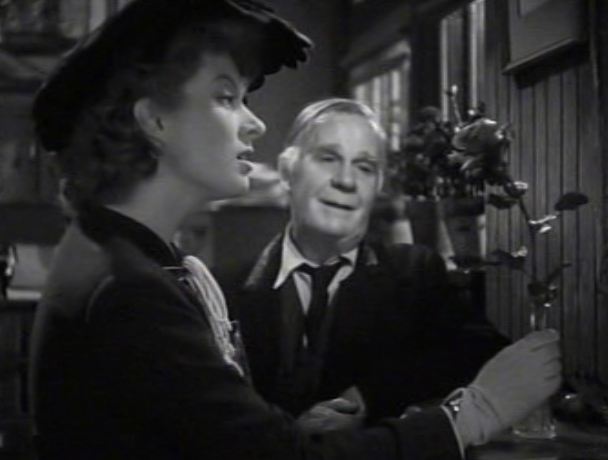
Gladys Cooper, who also teamed up with Jennifer Jones in “Song of Bernadette” (1943), see this previous post, plays Miss Jones’ guardian. She plays prominently in the tragedy/mystery, and she’s a shadowy figure for most of the film. It’s not until the very end we get her story and the truth about Victoria. It’s a good scene between Jones and Cooper, where they both reach back into their memories and describe a particular pivotal event, each finishing the other’s sentences.


The war in this movie, unlike in “Mrs. Miniver” and “The More the Merrier” is less on the surface of everyday life for these country dwellers and more in the fog-shrouded background, though there is one scene where Cotten, driving with Jones on winding lanes, does mention the gas rationing, “Since you love motoring so much, we’ll travel to the end of our coupons.”

Also, there is a scene with a wedding in what appear to be the bombed-out ruins of a church, evocative of the end of “Mrs. Miniver.” The war is still present in this movie, but it seems to be sliding into the background.

And I think that portrait of the little boy which figures in a couple of scenes that Joseph Cotten says is him as a child really was him. There is a similar photo in his autobiography, “Vanity Will Get You Somewhere” (Mercury House, Inc., San Francisco, 1987). In that book, he states that the photo was also used in “Shadow of a Doubt”.


The war is mostly represented in the letters he has written to her, and in his depression on coming home. He tells her, “Ever since I came back from the war, I’ve wanted to be alone. I’ve been miserable with other people. You’re the first one with whom I feel at peace.”

She replies, “That’s because you’re broken up inside almost the same as I am. You’ve been through the war and you can’t bear to look back.”

In this movie, and as World War II drifted into the past (the film was released in August 1945, after the Japanese surrender but before the formal surrender ceremonies in September), the generation that fought the war seemed to decide in large measure not to talk about it anymore. Many servicemen, like Joseph Cotten in the film, preferred not to look back.

Much of that war is documented in letters, and the intriguing notion that two people can fall in love without ever meeting each other…I would not hazard a guess as to how many times that actually happened. I don’t doubt that it did.

This is the end of our series on “war stories”. The all-clear has been sounded. Now get out of my cellar.  I'd better not be missing any cans of SPAM.

Monday, 29 November 2010

War Stories - Intro

For the next two weeks we're going to be discussing three movies that tell war stories. By “war stories” in this case we mean what are typically called home front movies. I think that the term home front usually implies a lack of conflict or danger. During World War II, most home fronts around the world were in a very great deal of danger, except for the United States. Our conflict was internal.

Without wanting to be too pedantic about it, I’d like to emphasize that The War (one senses when a member of that generation speaks about it, it’s always in capital letters), was more than setting or timeframe in these films; it was another character, like The Fates proclaimed by an ominous Greek chorus back in the days of Aeschylus. One railed against it, plotted to deceive it, tried to escape it, but in the end, The War determined everyone’s fate.

A typical “war movie” that shows battle is its own milieu. There are many fine battle films we can cover at some time in the future. But battles, however dramatically staged, are still staged. I believe the home front movies are the “war movies” that really show with a degree of reality what The War did to define that era.

Hollywood’s interesting conundrum was to address The War through an industry that was largely devoted to fantasy and entertainment. Far from looked upon as good material from which producers could prospect for stories (too much political tightrope walking, too great a risk for offending the public), nevertheless Hollywood was forced to acknowledge the elephant in the room. But the movies interpreted The War on its own terms: the war as melodrama, the war as romance, the war as comedy.

This blog, because it examines old movies within the context of the times in which they were filmed, shovels around a lot of history, which I know may be off-putting for some old movie buffs who just want to reminisce about favorite films or actors. But, I think without the history background, a good chunk of the pleasure of watching old movies, i.e., really understanding context, is lost. Many plots and conflicts transcend time. Many just don’t, and to appreciate them we need to bend their way rather than require they conform to our modern understanding.

Imagine sitting down to eat a pizza, everything on it you like.

Now imagine you have no taste buds.

If you eat it, you’ll still get all the calories. You won’t feel hungry anymore.

But you will have tasted nothing. It will be like eating the box it came in.

Watching an old movie without “getting it”, is like eating a pizza when you have no taste buds.

Understanding the background is what puts the color in a black and white movie.

Almost every line of dialogue, every costume or set piece in any old movie you’ve seen was for calculated effect. This is especially poignant when we watch “war stories”.

These three films for the next three posts are: “Mrs. Miniver” (1942), “The More the Merrier” (1943), and finally “Love Letters” (1945).

“Mrs. Miniver” starts our home front experience in England in the early days of World War II. The United States was not involved in the war at the time of the setting of this movie or even when filming began. Yet by the time the movie was shot and in the can, we were at war. It is famously and repeatedly referred to as propaganda, though in another post we discussed that this label is not entirely fair or accurate. We'll get a little more into that on Thursday.

The next movie, “The More the Merrier”, finds us in Washington, D.C. during the middle of the war. This film is a romantic comedy, but it shows some enlightening aspects of wartime tension, and entertaining scenes of sexual tension.

We see a decidedly different skew on home front patriotism in this movie. Where “Mrs. Miniver” gives us a certain stiff upper lip British pluck, “The More the Merrier” shows a more quintessentially American attitude that was evidenced during World War II. It's not exactly laid-back, and it is certainly just as patriotic, but there's a more chip on the shoulder attitude. We get repeatedly, if subliminally, the message that strife is congenial and that real patriots don't whine. An attitude we might benefit from today.

Both attitudes, to some extent, were whistling in the dark.

The final movie, “Love Letters” takes us back to England in the later days of the war.


This is also a romantic movie, but it is not a comedy. It is a melodrama that involves amnesia, and mixed up identifies and murder all against the backdrop of that peculiar fatalistic weariness that happened at the close of the war when everyone was not so much looking not for victory, but for a little peace and quiet. These characters just want to go to sleep for a little while. And forget everything that happened.

So join us on Thursday for “Mrs. Miniver” and the other two movies following next week. You won't need to pack up your troubles in your old kit bag, but you will need to bring along your ration books, and your patience, and your empathy.