“Callaway Went Thataway” (1951), continues our look at old movies as filler for programming on early TV, and on the “Hopalong” Cassidy phenomenon in particular. Not that Hoppy is actually mentioned, in fact the film ends with a careful disclaimer to that effect.
Fred MacMurray and Dorothy McGuire play ad executives who are making money hand over fist with their latest property, the redistribution of old “Smokey Callaway” B-movies to the hungry TV market. Even more, the merchandizing of Smokey Callaway toys, etc. But, the network execs decide this is such a good thing, they want to hire the cowpoke to make some brand new films. The problem is, Callaway is nowhere to be found. Enter a young look-alike, played by Howard Keel.
We are first introduced to the Hoppy, er, that is, Callaway phenomenon, through the montage of small children glued to the TV, watching their hero’s every move. This includes a couple of poker-faced young African-American kids, who, as discussed in
this previous post on Herb Jeffries, were given little by either Hollywood or TV in the way of a black hero to emulate. Clearly, we are shown that Callaway appeals to everybody in this democratic republic. It’s a cute shot, that can’t help but ring hollow. Grownups love him, too, including a fawning Natalie Schafer, who plays the wife of the big TV boss. You may remember her as Lovey in “Gilligan’s Island.”
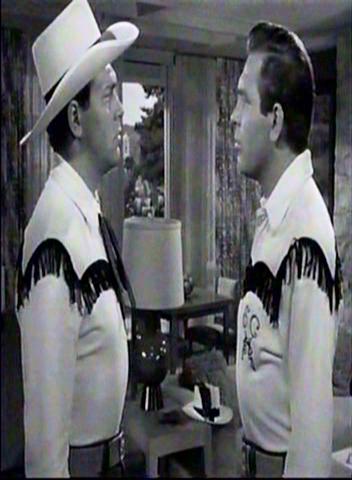
The team of MacMurray and McGuire are now up a creek, because the real Callaway disappeared to a life of dissipation years ago, and the look-alike cowboy they hire to play him wants nothing to do with TV. He is sincere, honest, naïve, and gentle. Howard Keel, with his choir boy haircut and soft speech, is adorable, and it’s kind of amazing to see him later on in the film playing the real Callaway, an obnoxious, womanizing boozer, with the same face, the same clothes, and yet actually appearing different. His voice booms and his face actually looks puffier, his hard, dim eyes glaring with suspicion and resentment.
But, until they find the real Callaway, they must utilize his erstwhile double, and on a coast to coast train trip, McGuire tries to impress upon Mr. Keel how important Smokey Callaway is as a role model to children. Along the way, he falls in love with her, but she is reluctant to submit to his aw-shucks charm.
She and MacMurray have that 1930s screwball comedy rapport with each other, but it’s somewhat forced and we are given to understand there is no romantic involvement between them. She undergoes a conversion when she falls in love with Howard Keel and decides the ad racket has gotten too deceitful for her. Mr. MacMurray never undergoes such a conversion, remaining a likeable, but undependable trickster to the end. MacMurray was so good playing guys on the knife edge of good and bad.
On their coast-to-coast trip we get some rear screen project of Niagara Falls, a lot of train interior shots, which is always lovely, but their stop in San Francisco appears to be really filmed there. There is also a bit at the end filmed at the Los Angeles Coliseum, so we might wonder what kind of build-up this movie had and what expense went into making it.
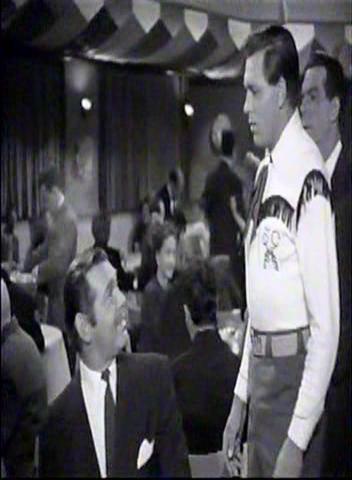
There are even a few star cameos. Esther Williams and her sons accost Keel in a hotel lobby, and later he meets Elizabeth Taylor and Clark Gable at the Mocambo, both of whom he greets effusively and neither of whom he recognizes.
Mr. Keel, who fairly hero-worships the (he thinks) saintly character he is playing, decides to set up a charitable foundation for children with his salary. But then, the real Smokey shows up like an evil twin, and wants all the moolah and all the swag that the team of MacMurray and McGuire have been generating. There is the inevitable fight scene between the good and evil Smokeys, and because they are wearing the same clothes, we don’t know who is who.
Finally, the real one learns of the charitable foundation set up by his look-alike, and bails out of the whole Smokey Callaway franchise. He doesn’t want any part of it if he can’t keep the money himself. The look-alike gets to keep the job.
Fred MacMurray tosses off a funny line with all seriousness, “What’s the Smokey Callaway Foundation? Have we got a girdle tie-in?”
We end with a rousing appearance at the Coliseum, and Miss McGuire’s 11th-hour commitment to being the sweetheart of a TV cowboy.
Both these films,
“Dreamboat” and “Callaway Went Thataway” harken back to the screwball comedies of a previous generation, but they land squarely in the present, using it as surely as any socially conscious dramatic film of that era did to bring reality to the movies. “Callaway” ends with the interesting disclaimer, as much a signpost to the era as the fake signpost it was printed on. (The opening screen titles on a similar signpost remind me of “My Darling Clementine.”)
“This picture was made in the spirit of fun, and was meant in no way to detract from the wholesome influence, civic mindedness and the many charitable contributions of Western idols of our American youth, or to be a portrayal of any of them.”
A case of methinks they doth protest too much?
Actually, Hopalong Cassidy, is the real hero on whom this movie is based. You might remember his showing up
Boris Karloff in the 1950 Macy’s Thanksgiving Parade, as discussed in this previous post. From the book “Total Television” by Alex M. Neal (Penguin Books, NY, 1996, 4th edition), we have a few stats on our hero. Hoppy made 66 B-movies from 1935 to 1948. William Boyd, who played Hoppy, cannily acquired the TV rights to his films, and re-edited them to fit 30 and 60-minute timeslots. According to author Mr. Neal, “thus, he was in a position to offer a readily available source of action programming to the rapidly expanding postwar television station market.”
His show ran from 1949 to 1951 on NBC, and then continued in syndication from 1952 to 1954. Hoppy was perfect for the new medium and the black and white sets: he dressed in black, and rode a white horse. Anybody remember Hoppy’s horse’s name?