Happy Presidents Day, for those of us in the U.S. Happy retail sales. Happy day off.
Others are more reverent. Here, Connie Milligan, clearly a Lincoln groupie, celebrates her favorite Commander-in-Chief all year long with a modest shrine. Below. Fred, Majorie, and a resentful Bing, pay homage to One Number in a pastiche of Washington clichés and American history via Irving Berlin.
(Remember to scroll down to the bottom of the page to mute the music so you can hear the video.)
Showing posts with label Bing Crosby. Show all posts
Monday, 21 February 2011
Monday, 31 January 2011
Snow...Snow...SNOW!
A tribute to those of you in the some 30 states who’ll be taking part in this week’s snow, slush, and ice festival…keep smiling.
(Scroll down to the bottom of the page to mute the music so you can hear the video.)
Thursday, 6 January 2011
Here Comes the Groom - 1951
“Here Comes the Groom” (1951) can be viewed through a prism of different spectrums, first and foremost perhaps, as the first in the last handful of movies directed by Frank Capra. There are pieces of Capra’s canon here: a smidgen of screwball comedy, a bit of social commentary. But, as if not too deeply touched by the great director, the film summons up all its parts and walks away on its own, flawed but triumphant just for getting there.
Maybe you could say the same for Frankenstein’s monster. It got up and walked away on its own, too. But, I have a fondness for the monster, and I have a fondness for this pretty delightful movie that tries hard to be more than it is.
Here we have Bing Crosby as a happy-go-lucky foreign correspondent in Paris writing about war orphans. Capra reminds us that we are still in the mopping up stage in the aftermath of World War II, when some six years after the war ended, Americans are getting a bit weary of it.
“The war orphan racket’s milked dry. It’s not news anymore,” Bing’s editor says, played by Robert Keith, who we last saw here in “I Want You” (1950). Words like UNESCO, the United Nations, the Atlantic Charter are bandied about, reminding us of the timeline this movie places us.
We even get a generous dose of the young Anna Maria Alberghetti as a blind orphan (her mother refused to “entertain” the enemy, we are told) singing “Caro None” from Verdi’s “Rigoletto” in an audition to be adopted by Alan Reed and Minna Gombell.
She is very sweet, and very good, and Alan Reed (AKA Fred Flintstone, as if you didn’t know), an opera impresario, adopts her and promises her not only a home but a bright career. The movie is barely ten minutes old and we already have our first happy ending.
(Does anybody else automatically think of the old line from the “Mary Tyler Moore” show, “Anna Maria Alberghetti in a taxi, honey…”?)
Perhaps Mr. Capra, too, is weary of the aftermath of World War II, because this is all that constitutes social commentary in this breezy musical, and we move on, tentatively, to the screwball comedy.
Bing Crosby, despite his efforts at finding homes for war orphans, is not really as much a hero as a lazy fellow for whom things always work out. Doing good comes as a coincidence.
Two of his orphan friends become his own adopted children (eventually): a rascally little boy played by Jacques Gencel, who displays admirable stewardship over the ever-adorable Beverly Washburn, who being younger and not really being French, doesn’t have much to say. We saw her last, I think in this post on “Old Yeller”, where she was a bit older and had a bit more to do.
I like little Jacques’s mimicking of Crosby on the phone.
Crosby receives a letter in the form of a recording, an interestingly used holographic image, from Jane Wyman, the gal he left behind. If he doesn’t high-tail it home, she’s going husband-hunting elsewhere.
Crosby flies home to stop her, with his two orphans, and we get a sudden smidgen of vaudeville right out of left field when several passengers erupt into song with Bing on the plane. “Misto Cristofo Columbo” is a bouncy, fun song about discovering America, as the orphans are about to do, and opening up freedom’s door for war refugees. It is sung by real-life impromptu USO troupe of Frank Fontaine, Phil Harris, Cass Daley, Dorothy Lamour, and Louis Armstrong. Nothing fun like that ever happens when I fly.
When he arrives with the kids in Boston, he discovers that Miss Wyman’s already bound for the altar that week with a millionaire, played by Franchot Tone. Mr. Tone makes a refreshing nemesis; he is handsome, intelligent, kind, and superior in every way. Crosby realizes he has his work cut out for him and he must be especially devious to steal Wyman away from this great guy.
But there is chemistry between Miss Wyman and Mr. Crosby that we discover right off the bat, despite her criticism of his maddeningly casual take on life. When she brings him to the office building of her real-estate investor employer, who is also her fiancé, to help Bing find a cottage for his young-uns, they demonstrate rapport and sparkling musicality in the number “In the Cool, Cool, Cool of the Evening”, which they warble from the office, to the elevator, and out into the street.
The song immediately became a big hit on the radio. Some of the audience then, and perhaps more so today, who had become used to thinking of Jane Wyman as a dramatic actress may have forgotten she started out a chorus girl and could belt a song out with the best of them.
Another fun “the gang’s all here” kind of aspect is engendered by so many familiar faces getting a piece of the action: James Barton and Connie Gilchrist as Jane’s “wrong side of the track” parents. (It was disapprovingly noted in a recent viewing of this film by one of my relatives that though Jane’s family is from Gloucester, Mass. and the movie takes place in Boston, nobody here has the proper accent. I don’t hold it against anybody, though. I can be big.)
We also have dear old Adeline De Walt Reynolds, who we featured once in this post, who gets a couple of funny lines. Charles Halton, who last showed up as the detective in “The Shop Around the Corner” shows up here as an immigration agent. H.B. Warner is one of Franchot Tone’s stodgy wealthy uncles.
The magnificent (so says anyone carrying a torch for him) Charles Lane as the FBI agent makes my day.
Chris Appel, who surprisingly made only two films, appears here as the frantic wedding arranger who cannot get anyone to cooperate during the wedding rehearsal.
Check out Jane Wyman’s wedding apparel, particularly the tiara and recall our series on the 1950s princess here, here, and here.
I’m saving the best for last. Alexis Smith. She plays the distant cousin of Franchot Tone who agonizingly harbors a secret crush on him. Her awkward, blue-blood tweediness has left her ignored by him and her family, until Bing Crosby takes her in hand and teaches her how to flirt, and how to wrestle, in order to give her the confidence to go after Franchot Tone, so that Crosby may have Miss Wyman to himself. Though it’s a preposterous scene, it’s also touching when we realize that Crosby is the only one to understand her feelings and to give her the confidence she desperately needs.
“You are beautiful. You’re a knockout,” he says, and especially compliments her height, something all shy tall girls need to hear.
Alexis Smith blooms under his rough-and-tumble tutelage, and becomes a bombshell. Later she will wrestle with Miss Wyman (or the stunt doubles will, actually), and declare her worthiness both as a member of the clan, and as an object of lust. She even gets to sing her own verse of “In the Cool, Cool, Cool of the Evening” a cappella.
I like when editor Robert Keith, who is a conspirator in her “education”, leaves to head back for the office and one of Miss Smith’s stockings snags a ride on the back of his hat.
At the 11th hour, amid busybody government officials, wisecracking newspapermen, a congregation of elite Boston society at the televised wedding of the year, Crosby’s conniving plans gel as everything else falls apart. Franchot Tone and Jane Wyman choose other partners, and it’s a happy ending where nobody is foiled, not really, because there were never really any bad guys.
Have a look below for “In the Cool, Cool, Cool of the Evening”. Note how it’s sung “live” and not lip-synched.
Below that, our USO troupe singing “Miso Cristofo Columbo”.
(Don’t forget to scroll down to the bottom and mute the music so you can hear the video.)
Monday, 27 September 2010
Now Playing - The Bells of St. Mary's
We’ll have to postpone a review of “Rich Man, Poor Man” for now, but stay tuned on Thursday for the winner of the DVD contest.
In the meantime, here’s an ad for “The Bells of St. Mary’s” (1946) with Bing Crosby and Ingrid Bergman, “plus selected short subjects.” I love the “Bing Sings 5 Songs All Sensational!” and underneath that, just “Ingrid Sings.”
Monday, 19 April 2010
Frumpy Grace Wins an Oscar
Grace’s ‘sensible’ shoes were so sensible that the only other persons I had ever seen wearing them were old maids who taught compulsory Latin in eastern prep schools…I had noticed the serene and elegant Grace who became awkward as a newborn colt when laughter overtook her. Now I could see, too, a Grace who was lusciously provocative on one night and decidedly frumpy on the next.
(From “The Bridesmaids” by Judith Balaban Quine, 1989, Weidenfeld & Nicholson, NY)
This past Saturday, London’s Victoria and Albert Museum opened a new exhibit on Grace Kelly’s style and elegance as manifested by a display of her gowns and costumes. As we note from the passage above, according to observations of more than one person who knew her well, Grace Kelly did not always appear as a fashion plate. She could be downright frumpy, sometimes. Today, we have a look at her Oscar-winning frumpy role in “The Country Girl” (1954).
There is a famous quote attributed to Judy Garland, with or without expletives, to the effect that Miss Garland lost the Oscar to Grace Kelly that year because Grace took off her makeup for her role in “The Country Girl”. That is obviously an oversimplification, albeit a funny one, of the rationale that beautiful women get good notices when they take on roles which do not showcase their beauty.
Whether or not that’s true, there is much to admire in Miss Kelly’s performance in this film that has more to do with the grit in her soul than the ratty sweater or the thick glasses.
“The Country Girl”, directed and screenplay by George Seaton, is based on the stage play by Clifford Odets, and though some shifting in characters and scenes occurs, and though we get a bit of the streets of New York and Boston backstage at the theater, the film hovers pretty closely to stage-like drama of long scenes in confined places. There is great conflict between the three main characters, so much that we are not distracted by the many minor characters in this film, most we probably barely notice. I can’t think of too many films where that happens.
One of the more noticeable supporting actors, Anthony Ross plays the irascible producer Mr. Cook with very real and understandable irritation, and adds effectively to the tension. He’s not a typical cigar-chomping cartoon of a producer, but a money man with lots of worries.
Bing Crosby plays Grace Kelly’s alcoholic actor husband, who has very little work and almost no self respect. This was his greatest role, and it is interesting that in the off stage scenes he appears truly desperate and wretched, but in the scenes where he is supposed to be on stage, he comes off rather like the bland façade of his usual movie nice guy roles. It is as if he is parodying himself in a cruel Bizarro-world skit. It really was a magnificent performance from this man who otherwise seldom seemed to take chances in his movie career.
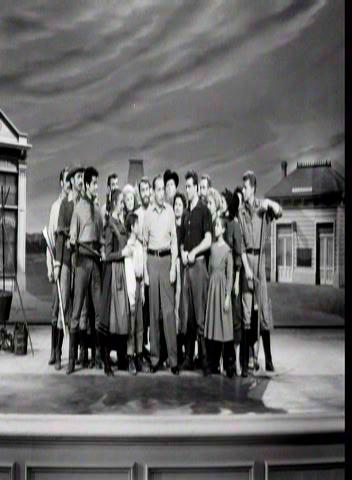
William Holden is the director who casts Crosby in his new musical play called “The Land Around Us”, which is a kind of parody itself of “Oklahoma!”, and it is very fitting this movie was filmed in black and white, because color might obliterate the real dismal feeling of this rather unremarkable-looking play with the loser Crosby in the lead. We are given the feeling we’re watching a train wreck about to happen. Color would impose a kind of make-believe to the on-stage scenes of this movie, and it’s better that the entire film be steeped in the reality of this man’s existence.
My only complaint on Mr. Crosby’s performance actually is that the tired, scared actor who broods in the wings does not seem to magically change into more than just the bland charming fellow he plays when on stage. He does not seem to have that burst of adrenalin that other performers are said to have, the aforementioned Judy Garland, for example, who were sometimes described as being reborn, who really came alive on stage during a performance no matter how physically terrible they felt just before they went on. Crosby looks miserable the whole time, and we may wonder how the poor man really can perform without a drink beforehand. A shot of courage, so called, has been a great crutch for many actors with stage fright.
Elaine Stritch, in her one-woman show told the story about a fellow actor’s response when she told him she gave up drinking before each show.
"You mean you're going out there alone?!" he replied.
The opposite of Bing Crosby’s utter wreck of a human being is William Holden’s decisive, self-confident, and somewhat arrogant director. But, Holden is not without his faults, or his endearing qualities, either. For the latter, we see him smiling fondly as he watches Crosby’s audition, like the admiring hatcheck boy he used to be when watching the big stars at the Shubert Theater. He may be a big shot director now, but deep inside he is still a star struck kid.
His faults lay mainly with his rudeness towards Grace Kelly, whom he mistakenly believes is a manipulative shrew, a millstone around Crosby’s neck. It’s Crosby that gives him that idea, and it doesn’t take much to convince Holden, because he had once been married to just such a woman, and his bitter experience has left him a bit of a misogynist.
Grace Kelly is the country girl of this piece, a woman intelligent, reserved, self-sufficient and, as we begin to see, almost heroically self-sacrificing. But she is no bravely cheerful Pollyanna. She is stoic, gut-wrenchingly pragmatic, and carries, like Holden, her own brand of bitterness and regret.
Grace Kelly’s dowdiness is often remarked upon in this role, to the point almost to neglect mentioning her actual performance, which was very good. But, as we note from the quote leading this essay, Miss Kelly could be dowdy in real life, and those glasses she wears in this film, I believe, were her own. She was quite nearsighted, but rarely wore her specs in public. This was probably the first time many of the general public saw her with her glasses on, and it was probably the first time she acted in a scene where she could see her costars clearly.
It should be noted that nearsighted people are almost always glamorous and elegant. This is the real secret to Grace Kelly’s beauty. (I have to stop here a minute and wipe my glasses. There. Okay, back to work.)
Though this film was one of the first, though certainly not the very first, to realistically portray the tragedy of alcoholism (and certainly not the only film that year, as the annoyed Miss Garland could attest), it is really more about the ones who have to cope with the alcoholics than it is about the disease. Grace Kelly in this role illustrates most eloquently the burden of always being someone’s keeper, most especially painful if that person is someone you love.
There is a toughness to her coupled with a vulnerability that is not fragile, but reveals deep reserves of emotion. Even Miss Kelly’s usual meticulously intoned speech is muted here. The lilt and precise diction of her other movie roles had been drilled into her at the American Academy of Dramatic Arts to diminish what was criticized by her teachers as a high, nasal-sounding Philadelphia twang. It left her with a sometimes artificial-sounding, but unmistakably unique speech that became her trademark.
(What comes to mind is the Kathleen Freeman role as the voice coach in “Singin’ in the Rain” who implored Jean Hagen, “Round tones, round tones!”)
Here she tones it down, speaking in a lower voice, almost guttural at times, and with a slight raspy sound to it, the way someone might sound with a dry throat who had been talking a lot. It is natural and layered with feeling.
There is an intense dynamic between the triangle of Crosby, Kelly, and Holden. Crosby evokes our pity, and also at the same time, our contempt for being so manipulative of his caretaker wife, of being such a colossal liar, and for betraying her time and again.
Holden is consistently standoffish and occasionally rude to Kelly, until he learns the truth about her relationship with Mr. Crosby, and turns his passionate hatred to passionate desire.
A flashback scene shows us Crosby’s real charm in former days and Kelly’s adoring warmth for him before the tragedy that ruined their lives, and turned him to drinking. Among the fine and delicate scenes is the one at the end of this flashback, when Grace enters their dingy apartment to find that a song on the radio has dropped on Crosby like a bomb and sent him to revisit old ghosts. We see on her face her horror, and her compassion as she rushes to snap off the radio.
Later there is a fight between them, and when she finds he is hiding beer bottles, the weariness enters her voice, “Where did you get these, Frank?” as one might talk pleadingly to a child who just cannot seem to help being naughty.
Crosby’s ultimate cruelty to her is that by using his guilt over the death of their son, by basking in it, he has reduced himself to an emotional invalid, which has taken away his wife’s right to grieve. We see she has been grieving over the wreck her husband has become, but we are left in doubt as to whether she was ever allowed to grieve for her son, or if she had to hide her grief to protect her husband.
During the play rehearsals, she stands backstage in his dressing room, helping him change, flustered, making mistakes. The competent caretaker is a fish out of water in this world. We see another side of her complicated husband when he rushes in to change his costume, complain and display his brittle ego and his pettiness. She is his whipping boy and his gofer.
After a terrific bender, Crosby is confronted by Holden, and the truth comes out, and their triangle dynamic shifts as the world spins on its axis. Holden comes to the sickening realization of his own mistake in judgment, which means even more to this egotistical man than his meanness to Miss Kelly or the shock that Crosby is no longer the hero from his boyhood.
Another couple of good scenes here I like is when Grace bails Bing out of jail after his night on the town, and we see in the foreground a very old, pitiful woman, counting out what is probably her food money to bail out her disreputable old husband, who stands in a stupor, uncaring. We get the feeling she has done this many times before, and it is like a foreshadowing of what will happen to Grace and Bing if things don’t change.
Another good scene is when Grace explodes at Holden after he realizes that Mr. Crosby is a huge problem on his hands and wants her help. The dialogue here is great, and gives us more explanation and more background than any flashbacks could. Grace shouts at him,
“Can you stand him up on his feet? Because that’s where all my prayers have gone to see that one holy hour when he can stand on his own feet again. I might forgive even you, Mr. Dodd, if you can keep him up long enough for me to get out from under! All I want is my own name, and a modest job to buy sugar for my coffee! You can’t believe that, can you? You can’t believe that a woman is crazy out of her mind to live alone, in one room, by herself!”
One complaint I have about the film is the, at times, rather distracting score. It makes heavy use of the DRAMATIC CHORD OF MUSIC TO TELL YOU THIS IS A REALLY DRAMATIC THING HAPPENING NOW. Too much. A lighter touch would have been better.
Also the typical of the day grab-the-woman forced kiss of Holden to Kelly is as overblown as the music and could have been tackled I think in a less melodramatic fashion.
In the end, redemption is at hand and choices have to be made, and Grace Kelly is still the focal point. She shows the many subtle facets of this woman, and through her, the many different sides of these two men.
Perhaps this country girl is not so self-sacrificing as she is simply a knowledgeable survivor. Maybe that’s what Grace Kelly had in common with her character that made her understand this role so well. Sometimes survival takes the form of surfing the moods of others, accommodating their needs, and denying you have needs of your own.
But, despite this excellent performance in her frumpy clothes, Grace Kelly will always be remembered for the elegance and style captured in her other films, and in the many exquisite photographs taken over the years by photographer Howell Conant.
The display at the Victoria and Albert Museum will present over 50 of Grace Kelly's outfits, including dresses from her films such as “High Society” (1956), as well as the gown she wore to accept her Oscar for “The Country Girl”. On display as well will be film clips and posters, photographs and her Oscar.
For more on the exhibit, which runs through September, have a look at this website.The latest issue of Vanity Fair has an article on this exhibit, have a look here. Here is a companion piece of photos.
This exhibit was also mentioned last week in our friend Laura’s blog, “Laura’s Miscellaneous Musings” with these Vanity Fair links provided by Moira Finnie of “Skeins of Thought” and TCM’s “Movie Morelocks” site.
Drop by my “Tragedy and Comedy in New England” site on Wednesday, when we’ll have a look at Grace Kelly’s Boston stage debut.
(From “The Bridesmaids” by Judith Balaban Quine, 1989, Weidenfeld & Nicholson, NY)
This past Saturday, London’s Victoria and Albert Museum opened a new exhibit on Grace Kelly’s style and elegance as manifested by a display of her gowns and costumes. As we note from the passage above, according to observations of more than one person who knew her well, Grace Kelly did not always appear as a fashion plate. She could be downright frumpy, sometimes. Today, we have a look at her Oscar-winning frumpy role in “The Country Girl” (1954).
There is a famous quote attributed to Judy Garland, with or without expletives, to the effect that Miss Garland lost the Oscar to Grace Kelly that year because Grace took off her makeup for her role in “The Country Girl”. That is obviously an oversimplification, albeit a funny one, of the rationale that beautiful women get good notices when they take on roles which do not showcase their beauty.
Whether or not that’s true, there is much to admire in Miss Kelly’s performance in this film that has more to do with the grit in her soul than the ratty sweater or the thick glasses.
“The Country Girl”, directed and screenplay by George Seaton, is based on the stage play by Clifford Odets, and though some shifting in characters and scenes occurs, and though we get a bit of the streets of New York and Boston backstage at the theater, the film hovers pretty closely to stage-like drama of long scenes in confined places. There is great conflict between the three main characters, so much that we are not distracted by the many minor characters in this film, most we probably barely notice. I can’t think of too many films where that happens.
One of the more noticeable supporting actors, Anthony Ross plays the irascible producer Mr. Cook with very real and understandable irritation, and adds effectively to the tension. He’s not a typical cigar-chomping cartoon of a producer, but a money man with lots of worries.
Bing Crosby plays Grace Kelly’s alcoholic actor husband, who has very little work and almost no self respect. This was his greatest role, and it is interesting that in the off stage scenes he appears truly desperate and wretched, but in the scenes where he is supposed to be on stage, he comes off rather like the bland façade of his usual movie nice guy roles. It is as if he is parodying himself in a cruel Bizarro-world skit. It really was a magnificent performance from this man who otherwise seldom seemed to take chances in his movie career.
William Holden is the director who casts Crosby in his new musical play called “The Land Around Us”, which is a kind of parody itself of “Oklahoma!”, and it is very fitting this movie was filmed in black and white, because color might obliterate the real dismal feeling of this rather unremarkable-looking play with the loser Crosby in the lead. We are given the feeling we’re watching a train wreck about to happen. Color would impose a kind of make-believe to the on-stage scenes of this movie, and it’s better that the entire film be steeped in the reality of this man’s existence.
My only complaint on Mr. Crosby’s performance actually is that the tired, scared actor who broods in the wings does not seem to magically change into more than just the bland charming fellow he plays when on stage. He does not seem to have that burst of adrenalin that other performers are said to have, the aforementioned Judy Garland, for example, who were sometimes described as being reborn, who really came alive on stage during a performance no matter how physically terrible they felt just before they went on. Crosby looks miserable the whole time, and we may wonder how the poor man really can perform without a drink beforehand. A shot of courage, so called, has been a great crutch for many actors with stage fright.
Elaine Stritch, in her one-woman show told the story about a fellow actor’s response when she told him she gave up drinking before each show.
"You mean you're going out there alone?!" he replied.
The opposite of Bing Crosby’s utter wreck of a human being is William Holden’s decisive, self-confident, and somewhat arrogant director. But, Holden is not without his faults, or his endearing qualities, either. For the latter, we see him smiling fondly as he watches Crosby’s audition, like the admiring hatcheck boy he used to be when watching the big stars at the Shubert Theater. He may be a big shot director now, but deep inside he is still a star struck kid.
His faults lay mainly with his rudeness towards Grace Kelly, whom he mistakenly believes is a manipulative shrew, a millstone around Crosby’s neck. It’s Crosby that gives him that idea, and it doesn’t take much to convince Holden, because he had once been married to just such a woman, and his bitter experience has left him a bit of a misogynist.
Grace Kelly is the country girl of this piece, a woman intelligent, reserved, self-sufficient and, as we begin to see, almost heroically self-sacrificing. But she is no bravely cheerful Pollyanna. She is stoic, gut-wrenchingly pragmatic, and carries, like Holden, her own brand of bitterness and regret.
Grace Kelly’s dowdiness is often remarked upon in this role, to the point almost to neglect mentioning her actual performance, which was very good. But, as we note from the quote leading this essay, Miss Kelly could be dowdy in real life, and those glasses she wears in this film, I believe, were her own. She was quite nearsighted, but rarely wore her specs in public. This was probably the first time many of the general public saw her with her glasses on, and it was probably the first time she acted in a scene where she could see her costars clearly.
Though this film was one of the first, though certainly not the very first, to realistically portray the tragedy of alcoholism (and certainly not the only film that year, as the annoyed Miss Garland could attest), it is really more about the ones who have to cope with the alcoholics than it is about the disease. Grace Kelly in this role illustrates most eloquently the burden of always being someone’s keeper, most especially painful if that person is someone you love.
There is a toughness to her coupled with a vulnerability that is not fragile, but reveals deep reserves of emotion. Even Miss Kelly’s usual meticulously intoned speech is muted here. The lilt and precise diction of her other movie roles had been drilled into her at the American Academy of Dramatic Arts to diminish what was criticized by her teachers as a high, nasal-sounding Philadelphia twang. It left her with a sometimes artificial-sounding, but unmistakably unique speech that became her trademark.
(What comes to mind is the Kathleen Freeman role as the voice coach in “Singin’ in the Rain” who implored Jean Hagen, “Round tones, round tones!”)
Here she tones it down, speaking in a lower voice, almost guttural at times, and with a slight raspy sound to it, the way someone might sound with a dry throat who had been talking a lot. It is natural and layered with feeling.
There is an intense dynamic between the triangle of Crosby, Kelly, and Holden. Crosby evokes our pity, and also at the same time, our contempt for being so manipulative of his caretaker wife, of being such a colossal liar, and for betraying her time and again.
Holden is consistently standoffish and occasionally rude to Kelly, until he learns the truth about her relationship with Mr. Crosby, and turns his passionate hatred to passionate desire.
A flashback scene shows us Crosby’s real charm in former days and Kelly’s adoring warmth for him before the tragedy that ruined their lives, and turned him to drinking. Among the fine and delicate scenes is the one at the end of this flashback, when Grace enters their dingy apartment to find that a song on the radio has dropped on Crosby like a bomb and sent him to revisit old ghosts. We see on her face her horror, and her compassion as she rushes to snap off the radio.
Later there is a fight between them, and when she finds he is hiding beer bottles, the weariness enters her voice, “Where did you get these, Frank?” as one might talk pleadingly to a child who just cannot seem to help being naughty.
Crosby’s ultimate cruelty to her is that by using his guilt over the death of their son, by basking in it, he has reduced himself to an emotional invalid, which has taken away his wife’s right to grieve. We see she has been grieving over the wreck her husband has become, but we are left in doubt as to whether she was ever allowed to grieve for her son, or if she had to hide her grief to protect her husband.
During the play rehearsals, she stands backstage in his dressing room, helping him change, flustered, making mistakes. The competent caretaker is a fish out of water in this world. We see another side of her complicated husband when he rushes in to change his costume, complain and display his brittle ego and his pettiness. She is his whipping boy and his gofer.
After a terrific bender, Crosby is confronted by Holden, and the truth comes out, and their triangle dynamic shifts as the world spins on its axis. Holden comes to the sickening realization of his own mistake in judgment, which means even more to this egotistical man than his meanness to Miss Kelly or the shock that Crosby is no longer the hero from his boyhood.
Another couple of good scenes here I like is when Grace bails Bing out of jail after his night on the town, and we see in the foreground a very old, pitiful woman, counting out what is probably her food money to bail out her disreputable old husband, who stands in a stupor, uncaring. We get the feeling she has done this many times before, and it is like a foreshadowing of what will happen to Grace and Bing if things don’t change.
Another good scene is when Grace explodes at Holden after he realizes that Mr. Crosby is a huge problem on his hands and wants her help. The dialogue here is great, and gives us more explanation and more background than any flashbacks could. Grace shouts at him,
“Can you stand him up on his feet? Because that’s where all my prayers have gone to see that one holy hour when he can stand on his own feet again. I might forgive even you, Mr. Dodd, if you can keep him up long enough for me to get out from under! All I want is my own name, and a modest job to buy sugar for my coffee! You can’t believe that, can you? You can’t believe that a woman is crazy out of her mind to live alone, in one room, by herself!”
One complaint I have about the film is the, at times, rather distracting score. It makes heavy use of the DRAMATIC CHORD OF MUSIC TO TELL YOU THIS IS A REALLY DRAMATIC THING HAPPENING NOW. Too much. A lighter touch would have been better.
Also the typical of the day grab-the-woman forced kiss of Holden to Kelly is as overblown as the music and could have been tackled I think in a less melodramatic fashion.
In the end, redemption is at hand and choices have to be made, and Grace Kelly is still the focal point. She shows the many subtle facets of this woman, and through her, the many different sides of these two men.
Perhaps this country girl is not so self-sacrificing as she is simply a knowledgeable survivor. Maybe that’s what Grace Kelly had in common with her character that made her understand this role so well. Sometimes survival takes the form of surfing the moods of others, accommodating their needs, and denying you have needs of your own.
But, despite this excellent performance in her frumpy clothes, Grace Kelly will always be remembered for the elegance and style captured in her other films, and in the many exquisite photographs taken over the years by photographer Howell Conant.
The display at the Victoria and Albert Museum will present over 50 of Grace Kelly's outfits, including dresses from her films such as “High Society” (1956), as well as the gown she wore to accept her Oscar for “The Country Girl”. On display as well will be film clips and posters, photographs and her Oscar.
For more on the exhibit, which runs through September, have a look at this website.The latest issue of Vanity Fair has an article on this exhibit, have a look here. Here is a companion piece of photos.
This exhibit was also mentioned last week in our friend Laura’s blog, “Laura’s Miscellaneous Musings” with these Vanity Fair links provided by Moira Finnie of “Skeins of Thought” and TCM’s “Movie Morelocks” site.
Drop by my “Tragedy and Comedy in New England” site on Wednesday, when we’ll have a look at Grace Kelly’s Boston stage debut.
Subscribe to:
Posts (Atom)